


What Is Vajrayana Buddhism? History, Beliefs, Practices, and Sacred Symbols
Vajrayana Buddhism, widely known as the Diamond Vehicle or Thunderbolt Vehicle, is one of the major traditions within Buddhism. Rooted in Mahayana philosophy, it brings together meditation, mantra recitation, sacred rituals, deity visualization, and profound teachings on the nature of reality. Practiced across Tibet, Nepal, Bhutan, Mongolia, and other parts of Asia, Vajrayana has shaped the spiritual traditions, artistic heritage, and cultural identity of the Himalayan region for centuries.
Unlike approaches that rely primarily on meditation, philosophical study, and ethical discipline, Vajrayana incorporates a distinctive range of tantric methods designed to transform ordinary experiences into opportunities for spiritual awakening. Its teachings emphasize wisdom, compassion, the guidance of a qualified spiritual teacher, and the understanding of one's true nature.
From beautifully crafted Buddhist statues and intricate mandalas to sacred vajras, ritual bells, and prayer beads, Vajrayana Buddhism has also developed a remarkable artistic and symbolic heritage.
But what exactly is Vajrayana Buddhism? What does its name mean, what are its central beliefs, and why are its deities, rituals, and sacred objects so important?
This guide explores the origins, philosophy, practices, symbols, and enduring cultural significance of Vajrayana Buddhism.
What Does Vajrayana Mean?
The word Vajrayana comes from two Sanskrit terms: vajra and yana.
- Vajra: Often translated as diamond or thunderbolt, the vajra symbolizes indestructible spiritual strength, clarity, and the wisdom that cuts through ignorance.
- Yana: Means vehicle or path, referring to a method or approach to spiritual awakening.
Together, Vajrayana means the Diamond Vehicle or Thunderbolt Vehicle. The name reflects the tradition's emphasis on the indestructible nature of awakened wisdom and its transformative methods for attaining enlightenment.
The vajra is also an important ritual object in Vajrayana Buddhism. Traditionally held together with a ritual bell, it represents the inseparable relationship between wisdom and method, two essential aspects of the Buddhist path.
Vajrayana is also known as Tantric Buddhism or Esoteric Buddhism because many of its advanced teachings and practices are transmitted through established spiritual lineages. Certain practices require formal empowerment and personal guidance from a qualified teacher.
History and Origins of Vajrayana Buddhism
Vajrayana Buddhism developed in India through the growth of Buddhist tantric traditions, which became increasingly established from around the late seventh century CE. Building upon the philosophical foundations of Mahayana Buddhism, these traditions introduced distinctive methods involving mantra, meditation, ritual, and deity visualization.
Indian Buddhist scholars, meditation masters, and tantric practitioners played important roles in developing and transmitting these teachings. Buddhist monasteries and centers of learning, including Nalanda and Vikramashila, became important environments for the study and preservation of Buddhist philosophy and tantric traditions.
The Spread of Vajrayana to Tibet
During the seventh and eighth centuries, Buddhism began taking deeper roots in Tibet through royal patronage, visiting teachers, translators, and Buddhist scholars.
One of the most celebrated figures in this history is Guru Rinpoche (Padmasambhava), an Indian Buddhist master traditionally credited with helping establish tantric Buddhism in Tibet during the eighth century. He holds a particularly important place in the Nyingma tradition and is deeply revered throughout Himalayan Buddhist communities.
Other influential teachers, including Shantarakshita and later translators and scholars, also contributed to the establishment and development of Buddhism in Tibet.
Over subsequent centuries, Tibetan Buddhist traditions developed extensive systems of philosophy, meditation, ritual practice, and monastic education. The teachings were preserved through different lineages, allowing Vajrayana Buddhism to flourish across the Himalayan region.
Vajrayana Buddhism in Nepal and the Himalayan Region
Nepal holds a particularly important place in the history of Vajrayana Buddhism. The Kathmandu Valley has long been home to distinctive Buddhist traditions, temples, monasteries, festivals, and artistic communities.
Newar Buddhism, practiced by the Newar Buddhist communities of the Kathmandu Valley, preserves a rich form of Vajrayana tradition. Its religious heritage includes elaborate tantric rituals, traditional manuscripts, sacred paintings, metal sculptures, and ceremonial objects.
Skilled Newari artisans have also played an important role in preserving Buddhist artistic traditions. Their work includes intricate metal statues, repoussé artwork, ritual implements, and detailed representations of enlightened Buddhist figures.
Vajrayana Buddhism also became deeply established in Bhutan and Mongolia. In Japan, Esoteric Buddhist traditions developed through a different historical transmission, most notably through the Shingon school.
Today, Vajrayana continues to be practiced across Asia and in Buddhist communities throughout the world.
Core Beliefs and Philosophy of Vajrayana Buddhism
Vajrayana Buddhism is rooted in the fundamental teachings of Mahayana Buddhism. It does not reject Mahayana philosophy but incorporates additional tantric methods into the broader path toward enlightenment.
Three essential principles form the foundation of its spiritual approach.
1. Bodhicitta: The Mind of Enlightenment
Bodhicitta refers to the aspiration to attain complete enlightenment for the benefit of all sentient beings.
It is one of the most important principles in Mahayana and Vajrayana Buddhism. Rather than seeking liberation solely for oneself, practitioners cultivate the intention to overcome suffering and help all beings attain freedom from ignorance.
Compassion, generosity, patience, and loving-kindness are essential qualities associated with this aspiration.
2. Shunyata: The Nature of Emptiness
Shunyata, commonly translated as emptiness, is a central teaching in Mahayana Buddhist philosophy.
It explains that all phenomena lack independent, permanent existence. Everything arises through causes, conditions, and relationships rather than existing entirely on its own.
Understanding emptiness helps practitioners overcome attachment, ignorance, and mistaken perceptions of reality. In Vajrayana, this understanding forms an essential foundation for tantric meditation and visualization practices.
3. The Bodhisattva Path
The bodhisattva path is dedicated to attaining Buddhahood for the benefit of all sentient beings.
Practitioners cultivate wisdom and compassion through ethical conduct, meditation, generosity, and other spiritual disciplines.
Vajrayana incorporates this Mahayana ideal while using tantric methods to deepen spiritual realization. Its distinctive approach is not simply about achieving enlightenment quickly but about transforming the way practitioners understand and experience themselves and the world.
What Makes Vajrayana Buddhism Different?
Vajrayana shares many teachings with Mahayana Buddhism, particularly the importance of compassion, emptiness, and the bodhisattva ideal. Its distinctive feature is the use of tantric methods as part of the spiritual path.
These methods include deity yoga, mantra recitation, mudras, mandalas, visualization, and advanced meditation practices.
One important principle is the transformation of ordinary experience. Rather than viewing difficult emotions and perceptions only as obstacles, certain Vajrayana practices work with these experiences through the understanding of emptiness and the cultivation of enlightened awareness.
Vajrayana is sometimes described as a rapid path to enlightenment. However, this does not mean that spiritual realization is effortless or guaranteed within one lifetime. The path traditionally requires extensive preparation, ethical discipline, appropriate instruction, and sustained practice.
Major Practices in Vajrayana Buddhism
Vajrayana Buddhism incorporates a variety of meditation and ritual practices. Each serves a particular purpose in cultivating concentration, wisdom, compassion, and spiritual realization.
1. Deity Yoga and Visualization
Deity yoga is one of the distinctive practices of Vajrayana Buddhism. It involves visualizing an enlightened figure, known as a yidam, and identifying with the qualities of awakened body, speech, and mind.
Important figures used in these practices include Avalokiteshvara, Green Tara, White Tara, Manjushri, and Vajrasattva.
Through visualization, practitioners cultivate qualities such as compassion, wisdom, protection, and purification. These practices are not simply exercises in imagining a divine being. They are grounded in Buddhist teachings on emptiness, Buddha-nature, and the transformation of ordinary perception.
2. Mantra Recitation
Mantra recitation is an important part of Vajrayana meditation and ritual practice.
A mantra is a sacred syllable or sequence of sounds associated with a particular enlightened figure or spiritual practice. Practitioners recite mantras to develop concentration, cultivate enlightened qualities, and maintain awareness during meditation.
One of the best-known Buddhist mantras is:
Om Mani Padme Hum
This six-syllable mantra is associated with Avalokiteshvara (Chenrezig), the bodhisattva of compassion. It is widely recited throughout Tibetan and Himalayan Buddhist communities.
Other well-known mantras are associated with Green Tara, Vajrasattva, Manjushri, and Guru Rinpoche.
3. Mudras and Sacred Gestures
Mudras are symbolic hand gestures used in Buddhist meditation, devotional practices, and tantric rituals.
Each mudra carries particular symbolic meaning and can represent qualities such as wisdom, compassion, fearlessness, generosity, and meditation.
Buddhist statues frequently depict enlightened figures with distinctive hand gestures. These gestures help communicate their spiritual qualities and the teachings associated with them.
- Bhumisparsha Mudra: Represents the Buddha's calling the earth to witness his enlightenment.
- Dhyana Mudra: Represents meditation and mental concentration.
- Abhaya Mudra: Symbolizes fearlessness and protection.
- Varada Mudra: Represents generosity, compassion, and the granting of blessings.
These gestures form an important part of Himalayan Buddhist sculpture and iconography.
4. Mandala Meditation
A mandala is a sacred geometric representation of an enlightened universe or a deity's palace.
In Vajrayana Buddhism, mandalas serve as important tools for meditation, visualization, and tantric rituals. Their carefully arranged patterns, symbols, and figures represent different aspects of enlightened wisdom.
Sand mandalas are among the most remarkable expressions of this tradition. Buddhist monks create intricate designs using colored sand, often spending many hours or days completing the work.
After completion, the mandala is traditionally dismantled in a ceremonial practice that illustrates the Buddhist teaching of impermanence.
5. Guru Yoga and Lineage Transmission
The relationship between a spiritual teacher and student is central to Vajrayana Buddhism.
Guru yoga is a practice through which practitioners cultivate devotion, inspiration, and a deeper connection with their spiritual teacher and the lineage of teachings.
Many advanced Vajrayana practices require empowerment, known in Sanskrit as abhisheka. An empowerment is a formal ritual through which a qualified teacher authorizes and prepares a student to undertake a particular tantric practice.
Oral instructions and continued guidance are also important. This lineage-based approach helps preserve the meaning, discipline, and traditional methods of Vajrayana practice.
Important Symbols in Vajrayana Buddhism
Vajrayana Buddhism is recognized for its rich visual language. Sacred objects, ritual implements, and artistic symbols communicate profound teachings about wisdom, compassion, enlightenment, and the nature of reality.
Many of these symbols appear in Buddhist temples, monasteries, traditional paintings, and Himalayan metal sculptures.
The Vajra (Dorje)
The vajra, also known as dorje in Tibetan, is one of the most recognizable ritual objects in Vajrayana Buddhism.
It represents indestructible wisdom and the power to overcome ignorance. Its symmetrical design symbolizes the unchanging nature of awakened awareness.
The vajra is traditionally used together with a ritual bell during tantric ceremonies and meditation practices.
The Ritual Bell (Ghanta)
The ritual bell, known as ghanta in Sanskrit, represents wisdom and the understanding of emptiness.
When paired with the vajra, the bell symbolizes the inseparable relationship between wisdom and method. Both are essential aspects of the path toward enlightenment.
Its distinctive sound is also used during Buddhist ceremonies and ritual offerings.
The Lotus Flower
The lotus is a widely recognized symbol throughout Buddhist traditions.
Growing from muddy water while remaining beautifully unspoiled, it represents purity, spiritual development, and the possibility of awakening.
Many Buddhist deities are depicted seated or standing upon lotus flowers, reflecting their enlightened nature.
The Buddhist Mala
A mala is a traditional string of prayer beads used to count mantra recitations and support meditation.
A commonly used Buddhist mala contains 108 beads, although other arrangements are also found. The beads help practitioners maintain concentration and establish a steady rhythm during recitation.
Mala beads may be made from materials such as wood, seeds, bone, or precious and semi-precious stones.
The Stupa
A stupa is a sacred Buddhist structure associated with the enlightened mind and the life and teachings of the Buddha.
Stupas are important objects of devotion and are traditionally used for circumambulation, meditation, and the preservation of sacred relics.
Their architectural form carries symbolic meanings connected with Buddhist teachings and the path toward awakening.
The Eight Auspicious Symbols
The Eight Auspicious Symbols, known in Sanskrit as Ashtamangala, are widely represented in Tibetan and Himalayan Buddhist art.
- Parasol: Represents protection from suffering and harmful influences.
- Golden Fish: Symbolizes freedom and liberation.
- Treasure Vase: Represents abundance, spiritual wealth, and fulfillment.
- Lotus: Symbolizes purity and enlightenment.
- Conch Shell: Represents the far-reaching sound of the Buddha's teachings.
- Endless Knot: Represents interdependence and the interconnected nature of existence.
- Victory Banner: Symbolizes the victory of wisdom over ignorance.
- Dharma Wheel: Represents the Buddha's teachings and the path to liberation.
These symbols frequently appear on Buddhist ritual objects, temple decorations, ceremonial vessels, and traditional sculptures.
Important Deities in Vajrayana Buddhism
Vajrayana Buddhism features a rich collection of enlightened figures, bodhisattvas, and meditation deities. Each represents particular qualities of awakening and plays an important role in Buddhist meditation, visualization, and devotional traditions.
Their images are carefully created according to traditional iconographic guidelines, with specific hand gestures, symbolic objects, postures, and ornaments.
Guru Rinpoche (Padmasambhava)
Guru Rinpoche, also known as Padmasambhava, is one of the most revered masters in Himalayan Buddhism.
Traditionally associated with the establishment of tantric Buddhism in Tibet during the eighth century, he holds a particularly important position in the Nyingma school.
He is commonly depicted holding a vajra in his right hand, a skull cup in his left hand, and a ritual staff known as a khatvanga. His imagery reflects his enlightened qualities and his role as a tantric master.
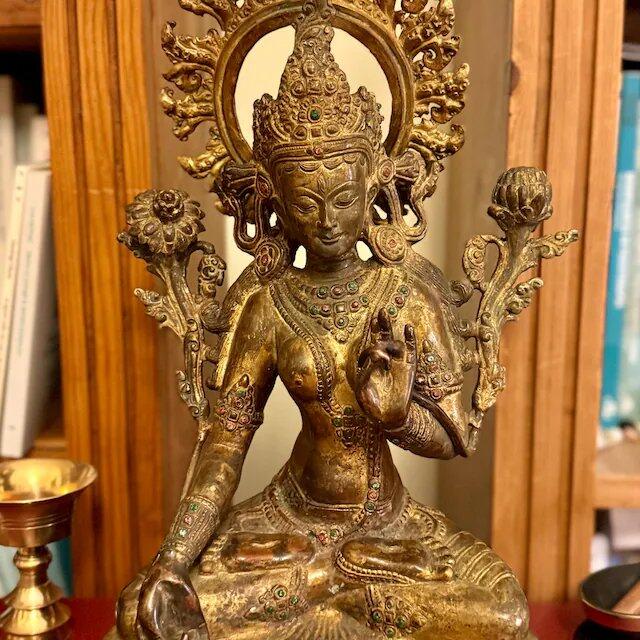
Green Tara
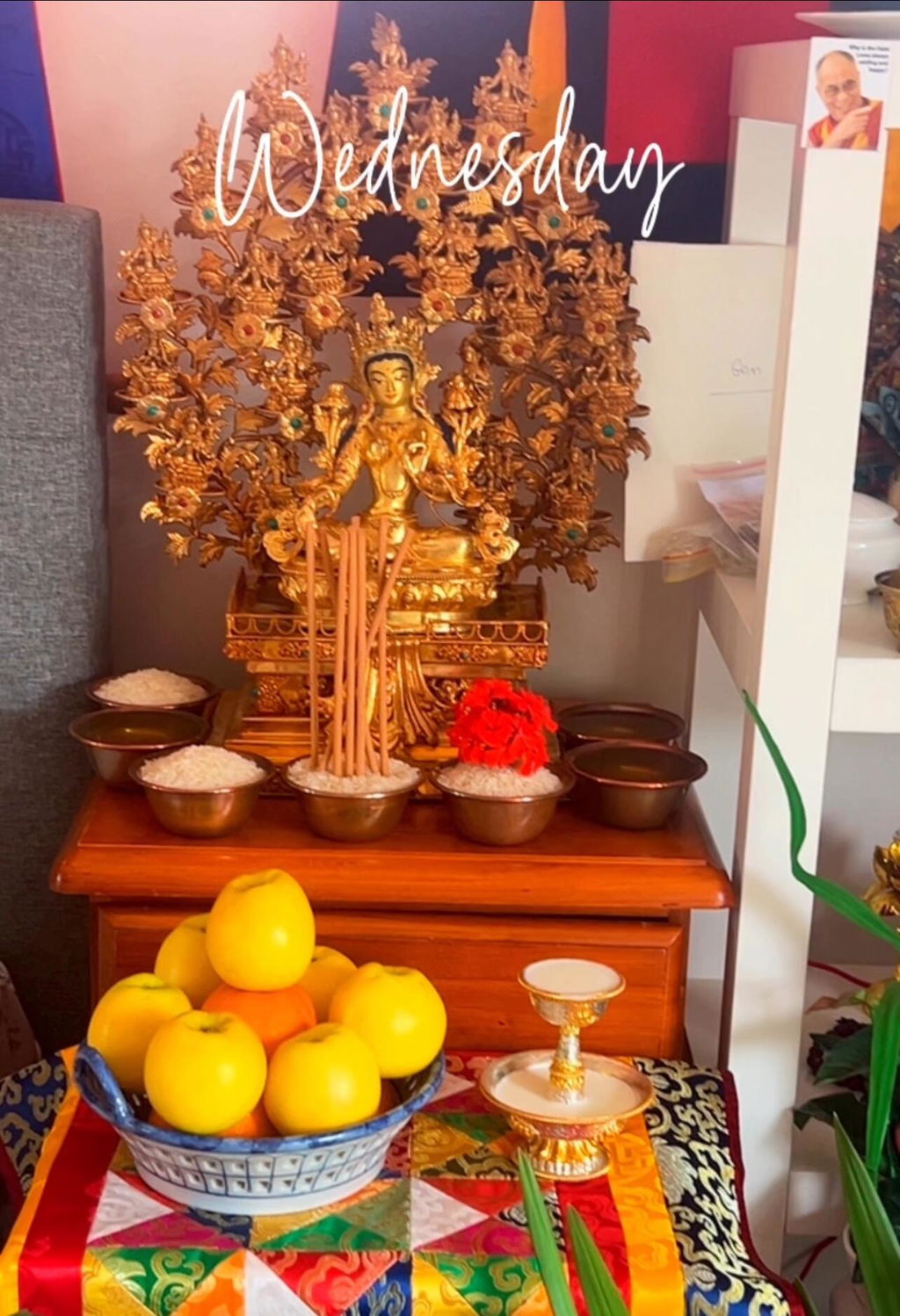
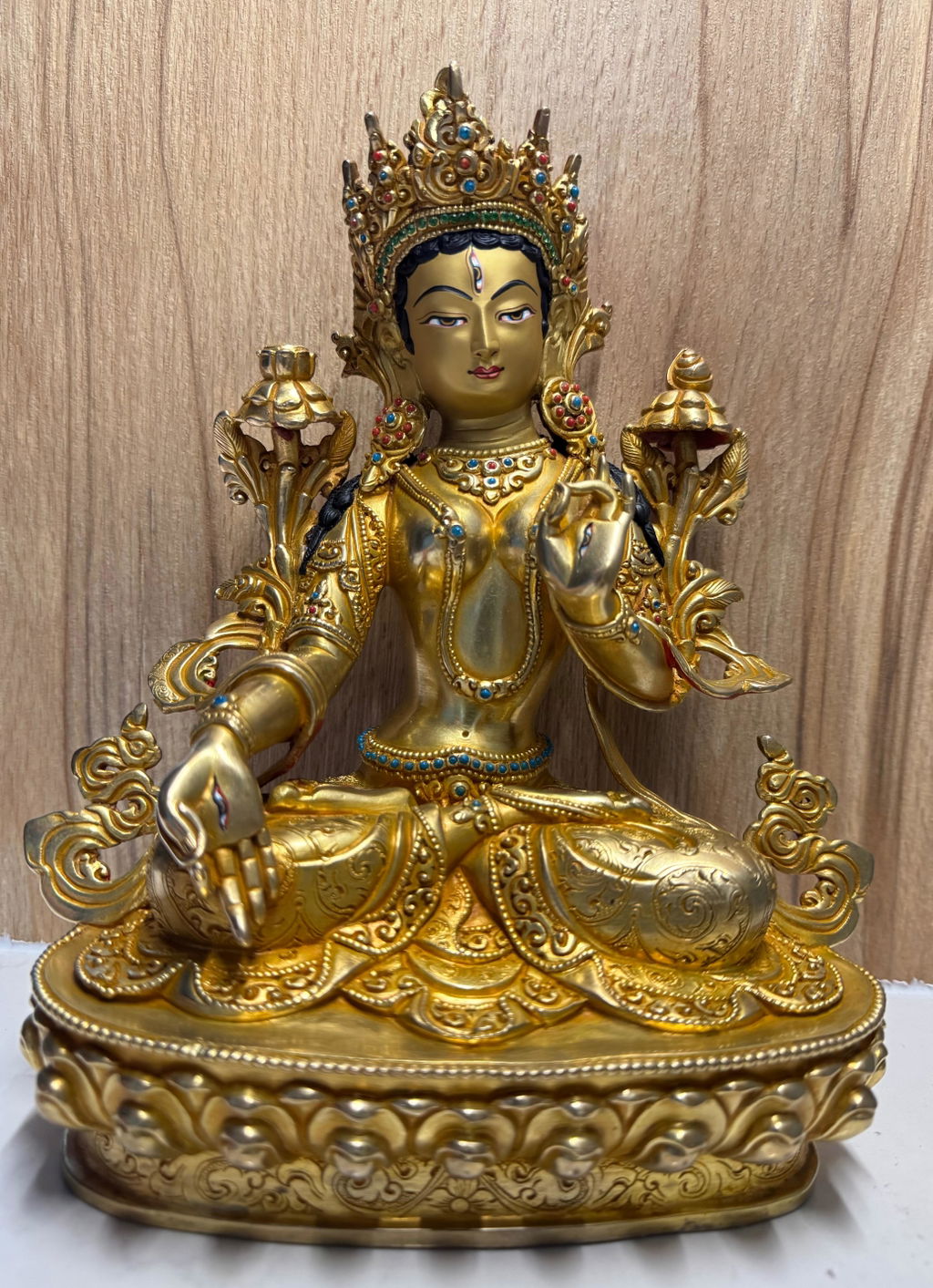
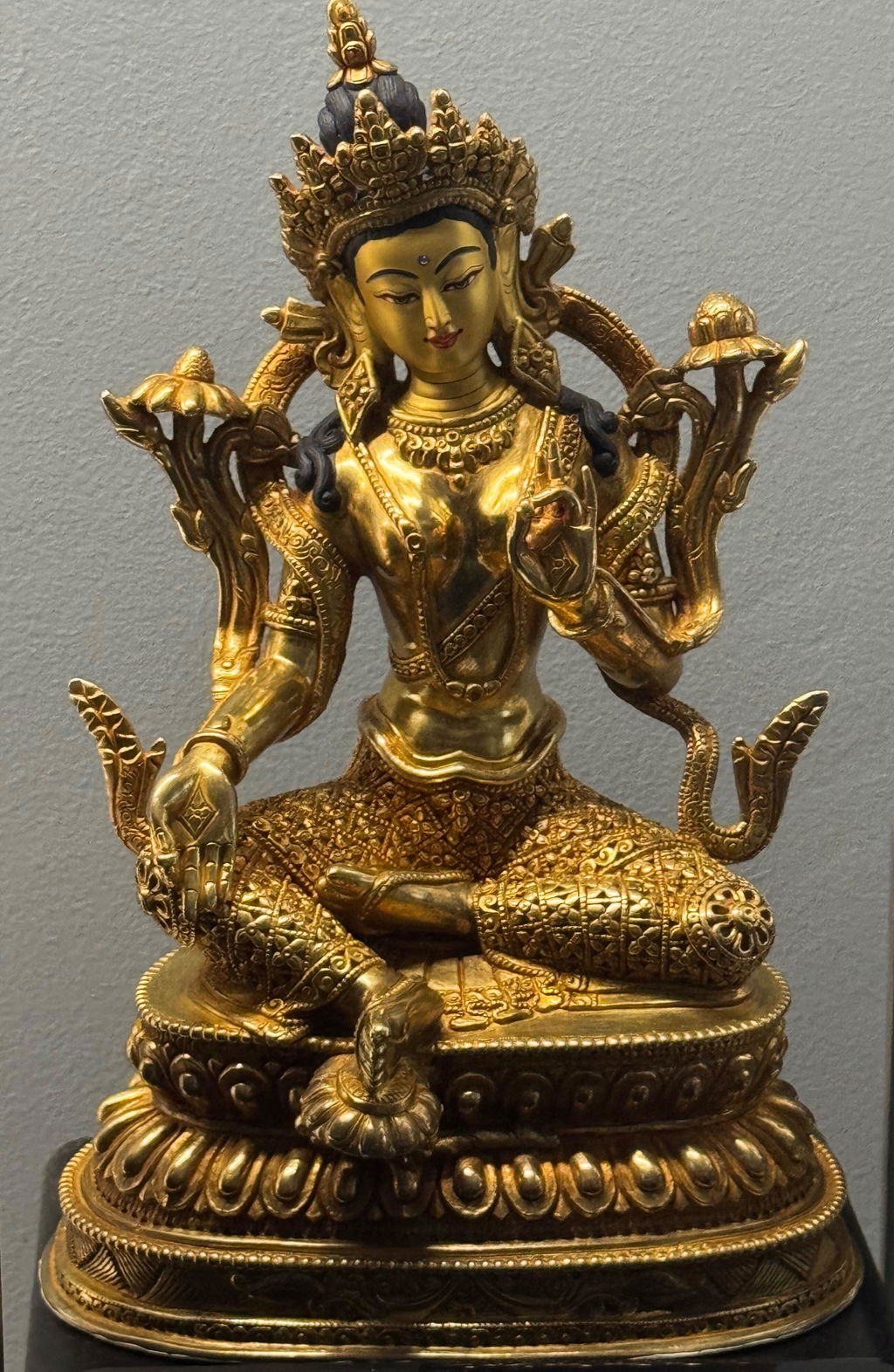
Green Tara is one of the most beloved female bodhisattvas in Vajrayana Buddhism. Revered as the Mother of Liberation, she represents enlightened activity, compassion, and protection from obstacles.
She is commonly depicted seated in the posture of royal ease, with her right leg extended and her left leg folded. Her hands form symbolic gestures of generosity and refuge, while lotus flowers appear beside her shoulders.
Green Tara is widely associated with the swift compassionate activity of the Buddhas.
White Tara
White Tara is associated with longevity, healing, compassion, and the removal of obstacles to long life.
She is traditionally depicted with seven eyes: one on her forehead, one on each palm, and one on each sole of her feet. These eyes symbolize her ability to perceive the suffering of sentient beings with profound compassion.
White Tara is an important figure in longevity practices and devotional traditions throughout the Himalayan Buddhist world.
Avalokiteshvara (Chenrezig)
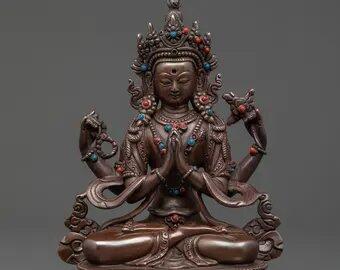
Avalokiteshvara, known as Chenrezig in Tibetan, embodies the compassion of all Buddhas.
He is commonly represented with four arms, holding a wish-fulfilling jewel, a crystal mala, and a lotus flower. His imagery represents the compassionate intention to relieve the suffering of all sentient beings.
The mantra Om Mani Padme Hum is traditionally associated with Avalokiteshvara and remains one of the most widely recited mantras in Tibetan Buddhism.
Manjushri
Manjushri is the bodhisattva of transcendent wisdom.
He is commonly depicted holding a flaming sword that symbolizes the cutting away of ignorance and a lotus supporting the Prajnaparamita text, which represents the perfection of wisdom.
Manjushri is particularly revered by students, scholars, and practitioners who seek to cultivate insight and understanding.
Vajrasattva
Vajrasattva is an important figure associated with purification and the restoration of spiritual commitments.
He is traditionally depicted holding a vajra in his right hand and a bell in his left. These ritual objects symbolize the inseparable relationship between wisdom and method.
Vajrasattva meditation is an important purification practice within several Vajrayana lineages.
Vajrayana Buddhism vs. Theravada and Mahayana Buddhism
Buddhism has developed into several major traditions, each preserving distinctive teachings, practices, and interpretations of the path toward liberation.
Theravada, Mahayana, and Vajrayana are commonly discussed as three major vehicles, although Vajrayana is generally understood as a tantric expression of Mahayana Buddhism rather than an entirely separate philosophical tradition.
| Aspect | Theravada | Mahayana | Vajrayana |
|---|---|---|---|
| Main spiritual ideal | Arhatship | Bodhisattva and Buddhahood | Buddhahood through tantric methods |
| Philosophical foundation | Early Buddhist teachings | Emptiness and bodhicitta | Mahayana philosophy and tantra |
| Main practices | Ethical conduct, meditation, wisdom | Bodhisattva practices, compassion, wisdom | Mantra, deity yoga, visualization, ritual |
| Important texts | Pali Canon | Mahayana sutras and commentaries | Mahayana sutras and Buddhist tantras |
| Teacher's role | Spiritual guide | Spiritual guide and lineage teacher | Qualified teacher and lineage transmission |
| Major regions | Sri Lanka and Southeast Asia | East Asia and other regions | Tibet, Bhutan, Nepal, Mongolia, and Japan's Esoteric Buddhist traditions |
Although their practices and philosophical approaches differ, these Buddhist traditions share fundamental teachings on suffering, impermanence, ethical conduct, and the possibility of liberation.
Major Schools of Tibetan Vajrayana Buddhism
Tibetan Buddhism developed into four principal schools, each preserving distinct lineages, teachings, and approaches to Buddhist practice.
1. Nyingma
Nyingma is traditionally regarded as the oldest school of Tibetan Buddhism. Its lineage is closely associated with Padmasambhava, Shantarakshita, and the early establishment of Buddhism in Tibet.
The school is particularly known for its teachings on Dzogchen, a profound approach to recognizing the nature of mind.
2. Kagyu
The Kagyu school is renowned for its meditation lineages and emphasis on direct spiritual instruction.
Important historical figures include Marpa, Milarepa, and Gampopa. Its teachings place considerable importance on meditation, the relationship between teacher and student, and the realization of the nature of mind.
3. Sakya
The Sakya school developed around the Sakya monastery in Tibet and became an important center of Buddhist scholarship and spiritual practice.
It is particularly associated with the Lamdre teachings, which combine philosophical study, meditation, and tantric instruction.
4. Gelug
The Gelug school was founded by Je Tsongkhapa in the early fifteenth century.
It emphasizes rigorous philosophical study, monastic discipline, and the integration of Buddhist scholarship with meditation. The Dalai Lama belongs to the Gelug tradition, although his spiritual significance extends beyond a single school.
Together, these four traditions have played an important role in preserving and transmitting Tibetan Vajrayana Buddhism across generations.
Common Misconceptions About Vajrayana Buddhism
Despite its growing global recognition, Vajrayana Buddhism is sometimes misunderstood. Several common misconceptions deserve clarification.
Misconception 1: Vajrayana Buddhism is only Tibetan Buddhism.
Although Tibetan Buddhism is one of its best-known expressions, Vajrayana traditions also developed in Nepal, Bhutan, Mongolia, and other parts of Asia. Japanese Esoteric Buddhism, particularly the Shingon school, represents another important historical development of Buddhist tantra.
Misconception 2: Vajrayana is primarily about rituals and magical practices.
Rituals, sacred objects, and symbolic imagery are important parts of Vajrayana. However, they are connected to deeper philosophical teachings on emptiness, compassion, wisdom, and the nature of mind. Ritual alone is not the ultimate purpose of the tradition.
Misconception 3: Anyone can perform advanced tantric practices by following a book.
Many advanced Vajrayana practices traditionally require empowerment, oral instructions, and guidance from a qualified teacher. Reading about a practice is not necessarily the same as being authorized or prepared to undertake it.
Misconception 4: Vajrayana Buddhism is separate from Mahayana Buddhism.
Vajrayana builds upon Mahayana philosophy and the bodhisattva ideal. Its distinctive feature is the use of tantric methods as part of the broader path toward enlightenment.
The Cultural and Artistic Heritage of Vajrayana Buddhism
Beyond its philosophical teachings and spiritual practices, Vajrayana Buddhism has inspired an extraordinary artistic tradition throughout the Himalayan region.
Buddhist temples, monasteries, traditional paintings, metal sculptures, and ritual objects reflect centuries of religious devotion and artistic knowledge.
Nepal, particularly the Kathmandu Valley, has played an important role in preserving this heritage. Newari artisans are internationally recognized for their traditional metalworking skills and detailed Buddhist sculptures.
Traditional Buddhist Metal Sculptures
Buddhist statues are among the most recognizable artistic expressions of Vajrayana traditions.
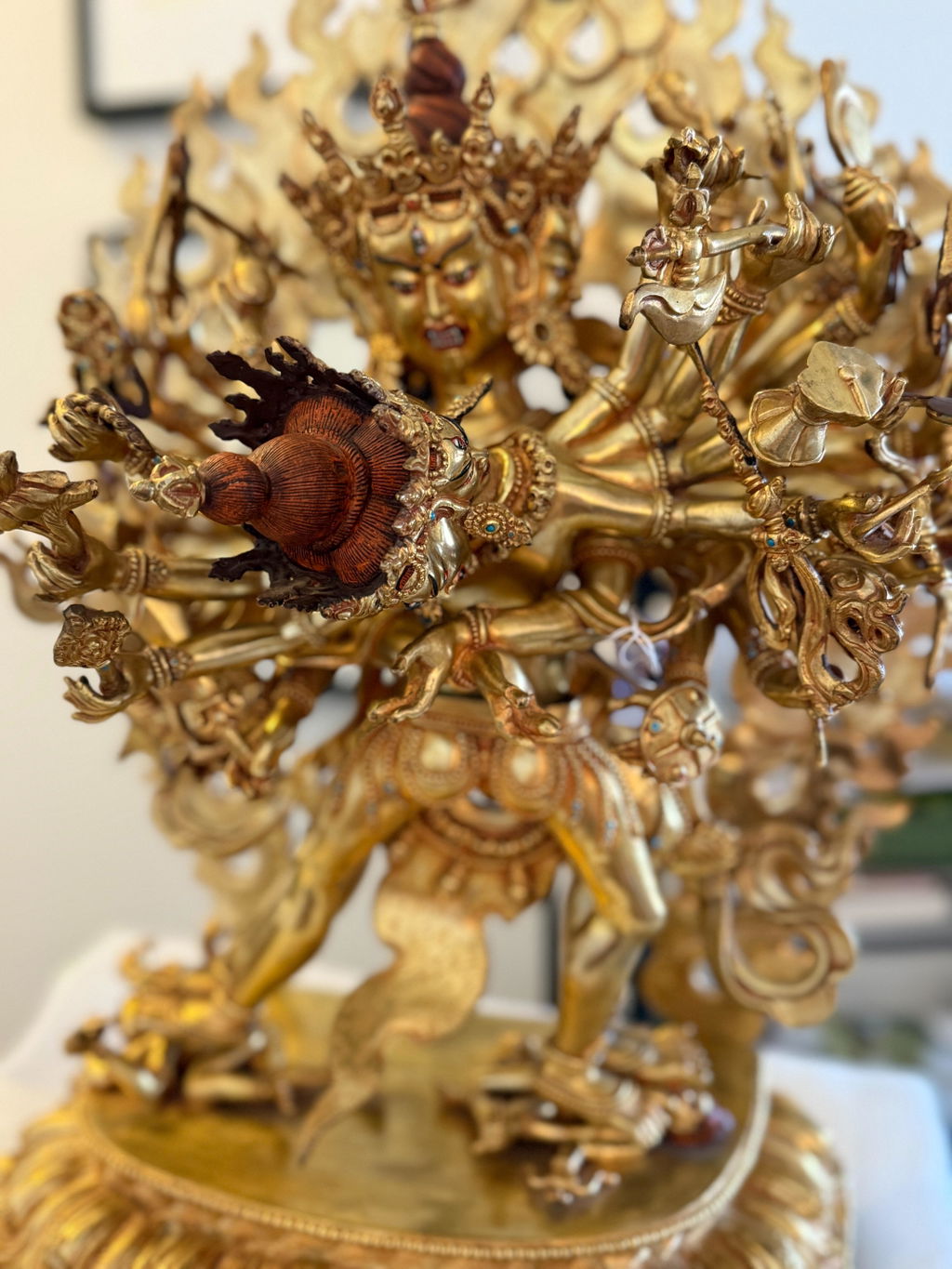
Figures such as Guru Rinpoche, Green Tara, White Tara, Manjushri, and Vajrasattva are represented through carefully developed iconographic forms.
Traditional Nepalese sculptures are often created using the lost-wax casting technique, followed by detailed finishing processes such as hand-chasing, engraving, repoussé work, and gilding.
Depending on the sculpture, artisans may incorporate copper, bronze, silver, gold, and semi-precious stones to create intricate details.
Each figure's posture, hand gesture, facial expression, and symbolic attributes communicate particular Buddhist teachings.
Buddhist Ritual Objects
Ritual objects also hold an important place in Vajrayana ceremonies and meditation practices.
- Vajra and Bell: Used together in tantric rituals to represent wisdom and method.
- Mala Beads: Used for counting mantra recitations during meditation.
- Mandala Offering Set: Used in traditional practices symbolizing the offering of the universe.
- Offering Bowls: Used for presenting traditional water offerings and other devotional offerings.
- Incense Burner: Used for burning incense during prayers, meditation, and ceremonial practices.
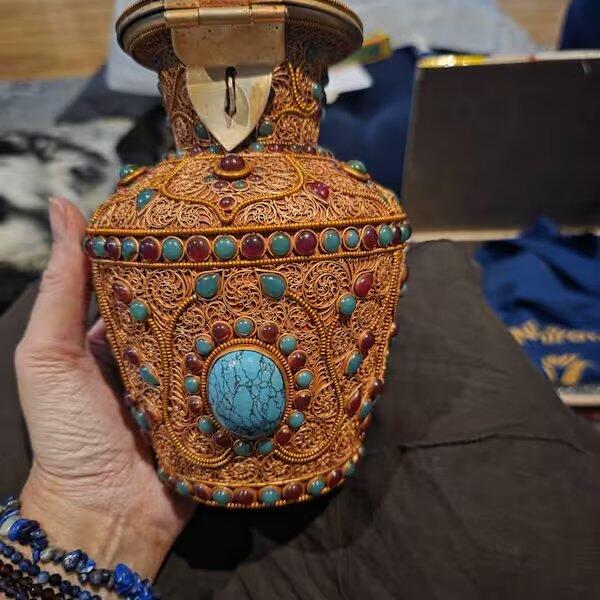
- Ghau Box: A traditional portable shrine or reliquary used to hold sacred images, texts, or other devotional objects.
These objects reflect the relationship between spiritual practice, artistic craftsmanship, and the preservation of Himalayan Buddhist culture.
Why Vajrayana Buddhism Continues to Inspire People Around the World
Vajrayana Buddhism continues to attract interest from people across different cultures and backgrounds.
Its philosophical teachings offer profound perspectives on compassion, wisdom, impermanence, and the nature of reality. Its meditation traditions provide structured methods for developing concentration and awareness, while its sacred art communicates complex spiritual ideas through visual symbolism.
The global presence of Tibetan Buddhist teachers, monasteries, meditation centers, and cultural institutions has also contributed to a wider appreciation of its traditions.
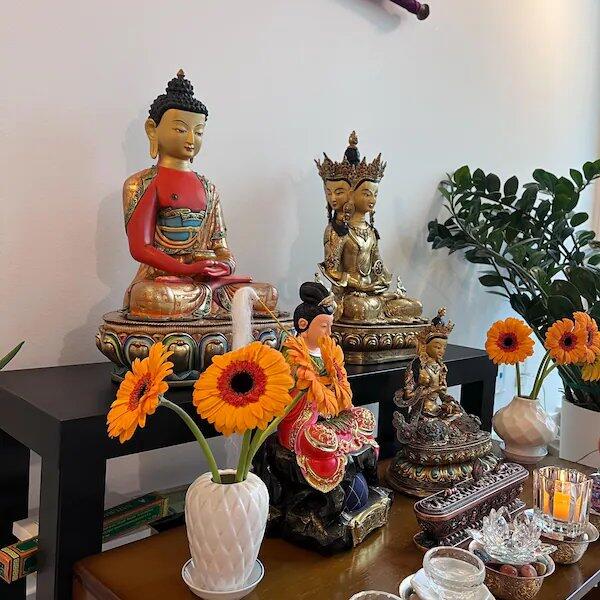
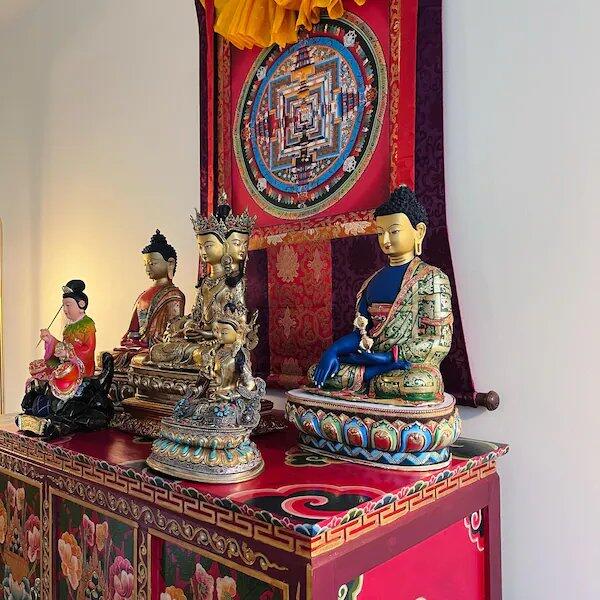
For many people, Himalayan Buddhist art provides another way to engage with this heritage. Traditional statues, mandalas, ritual implements, and sacred paintings preserve the teachings and artistic expressions that have been passed down through generations.
Whether approached through philosophical study, meditation, cultural appreciation, or artistic exploration, Vajrayana Buddhism remains a remarkable part of the world's spiritual heritage.
Final Thoughts
Vajrayana Buddhism represents a profound spiritual tradition that combines Mahayana philosophy with meditation, mantra recitation, sacred symbolism, and tantric practices. Through the guidance of qualified teachers and established spiritual lineages, practitioners follow a path dedicated to cultivating wisdom, compassion, and enlightenment.
Its rich artistic heritage is reflected in Buddhist statues, mandalas, ritual objects, and sacred symbols that continue to hold deep significance in Himalayan Buddhist culture. These traditional forms of art preserve centuries of spiritual knowledge, craftsmanship, and devotion.
At Nidhiratna, we celebrate this remarkable cultural heritage through authentic Nepalese Buddhist statues and traditional ritual objects, helping preserve the artistry and symbolism of Himalayan Buddhist traditions for future generations.
Explore Nidhiratna's collection of traditional Buddhist statues and ritual objects to discover the craftsmanship and cultural heritage of Himalayan Buddhism.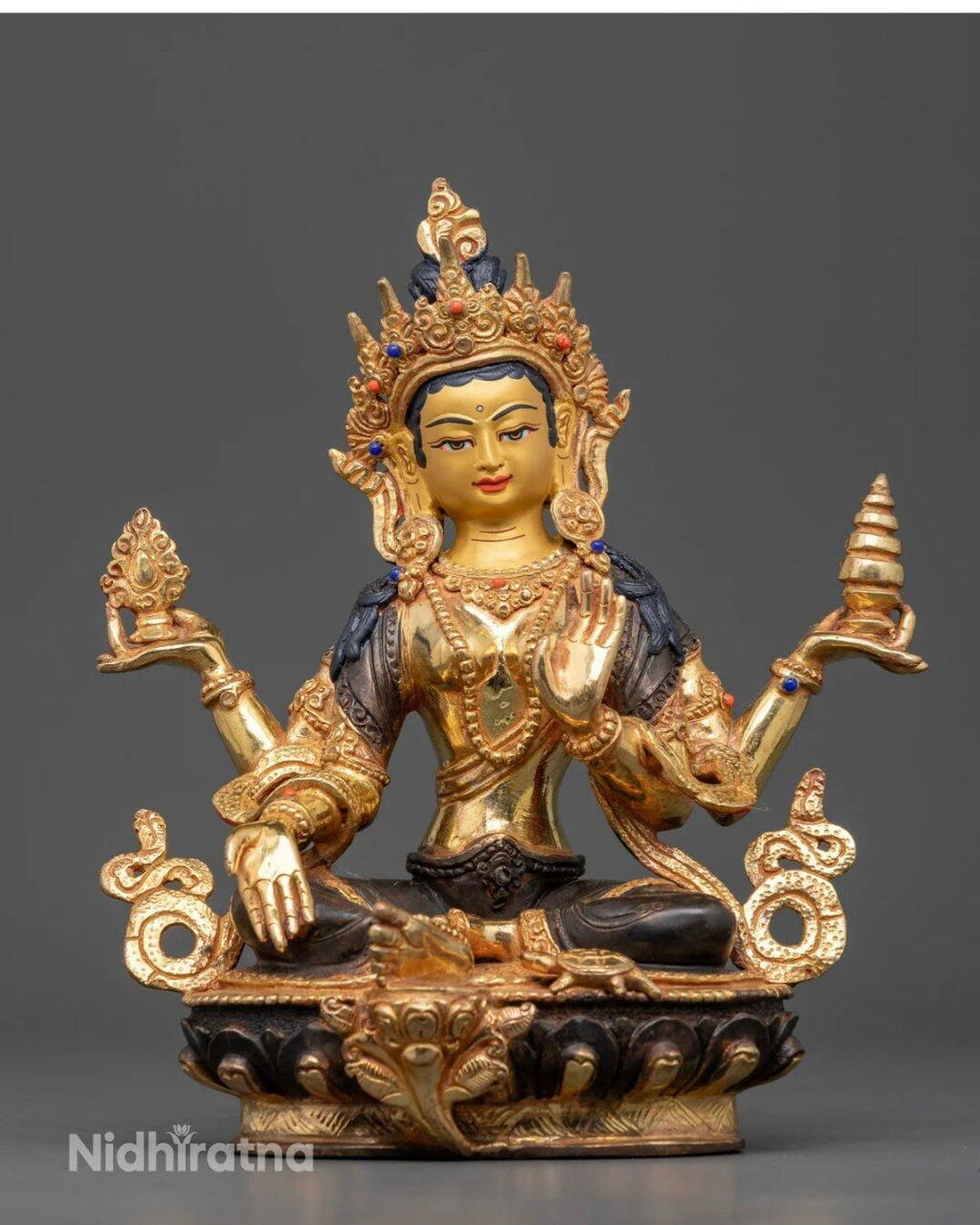
Share:
21 Taras in Tibetan Buddhism: Meanings and Symbolism