

Vajradhara: Meaning, Symbolism, Iconography & Spiritual Significance
Among the many profound figures found in Vajrayana Buddhism, Vajradhara occupies a particularly important place. He is not simply another Buddha figure represented in Himalayan Buddhist art. In traditions that identify Vajradhara as the primordial Buddha, he represents the Dharmakaya, the truth body of enlightenment and the deepest nature of awakened mind.
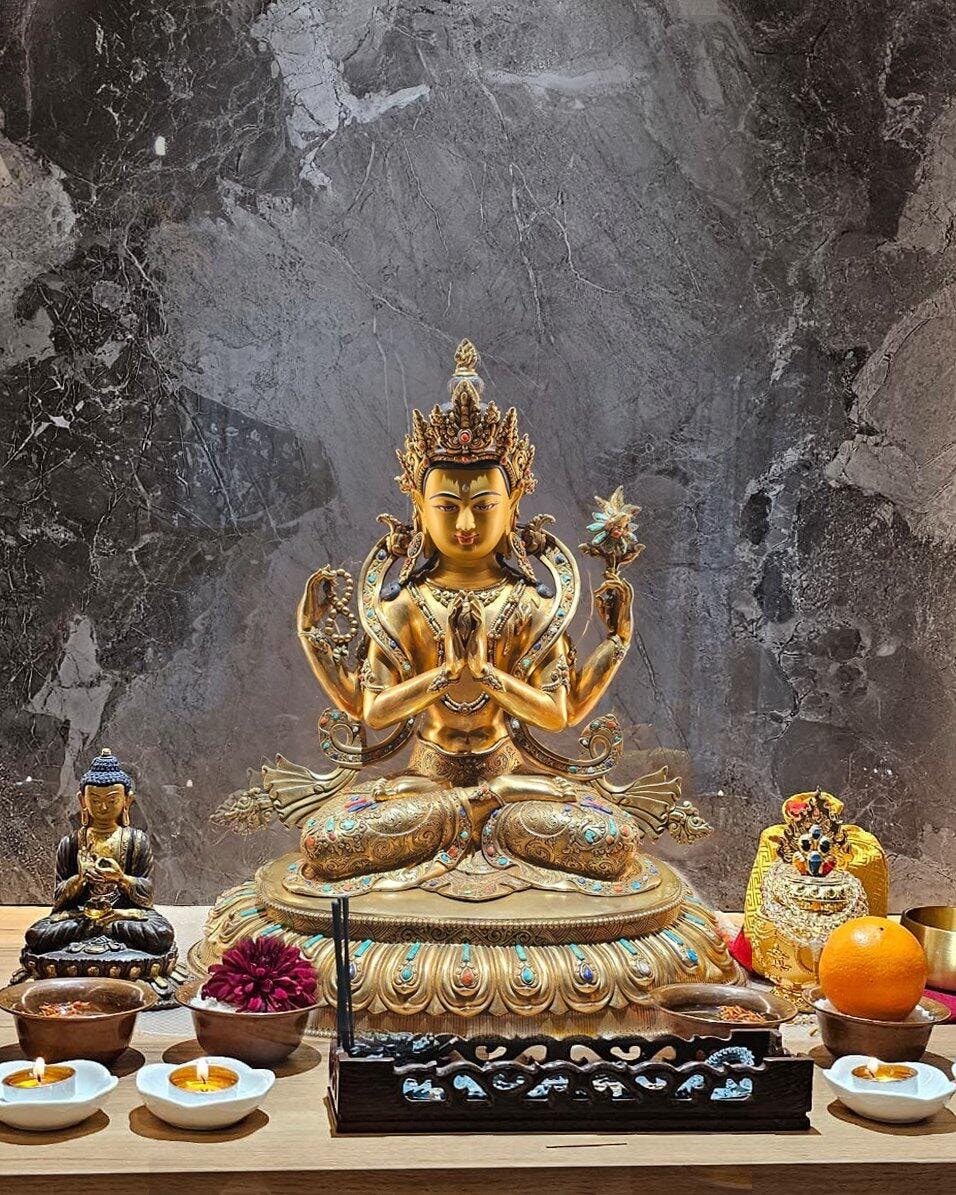
For someone encountering a Vajradhara statue for the first time, his appearance can be intriguing. Unlike Shakyamuni Buddha, who is commonly shown in simple monastic robes, Vajradhara appears richly adorned with ornaments and holds a vajra and bell crossed at his heart. Every part of this peaceful image carries meaning.
Understanding Vajradhara therefore means looking beyond the beauty of the statue and into the ideas it represents: primordial wisdom, emptiness, compassion, awakened awareness, and the inseparable union of method and wisdom.
Who Is Vajradhara?
Vajradhara, known in Tibetan as Dorje Chang, is regarded as the primordial Buddha in several Tibetan Buddhist traditions, particularly the Sakya, Kagyu, and Gelug traditions. He is closely associated with the Dharmakaya, the ultimate or truth dimension of buddhahood.
The name Vajradhara can be understood as “Holder of the Vajra.” His identity is closely connected with the Vajrayana understanding of enlightenment itself.
Rather than thinking of Vajradhara as a historical person who lived at a particular time, it is more useful to understand him as a symbolic and spiritual expression of complete awakening. In the Kagyu tradition, for example, Vajradhara is central to the lineage because the transmission of teachings is traditionally traced back through Vajradhara to great Indian masters such as Tilopa.
This gives Vajradhara a special position in Himalayan Buddhist practice. He represents not merely the beginning of a lineage but the awakened reality from which the teachings arise.
Vajradhara and the Meaning of the Primordial Buddha
The term Primordial Buddha, or Adi-Buddha, can sound mysterious at first. It does not necessarily mean a creator god or a deity who created the universe. Within Vajrayana Buddhist thought, the concept points toward the primordial nature of awakened awareness rather than a creator figure.
Vajradhara is therefore associated with the fundamental nature of buddhahood. Different Tibetan Buddhist traditions explain the relationship between Vajradhara and other primordial Buddha figures in somewhat different ways, so the terminology should always be understood within its particular lineage context.
This distinction is important because Vajradhara should not be understood through the same framework used for ordinary gods or divine beings. He represents the realization of enlightenment itself.
What Does Vajradhara Look Like?
Traditional Vajradhara iconography is remarkably distinctive. He is generally portrayed as a youthful Buddha with a deep blue or dark blue body, seated in meditation posture. Unlike the historical Buddha Shakyamuni, Vajradhara wears the elaborate ornaments associated with the Sambhogakaya form.
These ornaments may include a crown, necklaces, bracelets, earrings, armlets, and other finely worked jewelry. His hands are crossed before his chest in a gesture commonly known as Vajrahumkara Mudra.
In his hands he holds two essential ritual objects:
- Vajra in the right hand
- Bell or ghanti in the left hand
The vajra and bell cross at his heart, making this one of the easiest ways to recognize Vajradhara in Himalayan Buddhist art. His peaceful expression and balanced posture reinforce the sense of profound inner realization rather than worldly power.
The Meaning of Vajradhara's Blue Color
One of the most recognizable features of Vajradhara is his dark blue body. Blue in Vajrayana Buddhist imagery can evoke the vastness and depth of awakened reality. It can also be understood in relation to the limitless nature of wisdom and the sky-like quality of mind.
The color should not be treated simply as an artistic choice. In Himalayan Buddhist sculpture, color frequently functions as a visual language through which philosophical and spiritual qualities are communicated.
Vajradhara's deep blue appearance therefore contributes to the sense that he represents something vast, profound, and beyond ordinary conceptual limitations.
The Vajra: Indestructible Reality
The vajra is one of the most important symbols in Vajrayana Buddhism. The Sanskrit word vajra carries associations with both the diamond and thunderbolt. The diamond suggests something indestructible and unbreakable, while the thunderbolt evokes tremendous power.
In Vajradhara's hands, the vajra is more than a ritual object. It points toward the indestructible nature of awakened reality.
The vajra is also associated with method or skillful means, particularly when understood together with the bell. Their significance becomes much clearer when the two are considered as a pair rather than separately.
The Bell: Wisdom and Insight
The bell held by Vajradhara represents wisdom, often associated with prajna. In Vajrayana symbolism, wisdom is especially connected with the realization of emptiness, the understanding that phenomena do not possess the independent and permanent existence we ordinarily imagine them to have.
The bell and vajra therefore form an important symbolic partnership.
The vajra represents method or skillful means, while the bell represents wisdom. Their union expresses the inseparability of these two aspects of the Buddhist path.
Why Are the Vajra and Bell Crossed at the Heart?
The position of Vajradhara's hands is not accidental. He holds the vajra and bell crossed over his heart, bringing method and wisdom together at the center of his body.
Symbolically, this expresses a fundamental principle of Vajrayana Buddhism: wisdom and compassionate method cannot be fully separated on the path to awakening.
Wisdom without compassionate activity can remain incomplete, while compassionate activity without profound understanding can lack the insight necessary for liberation.
Vajradhara's posture presents these qualities as inseparable. The heart position also gives the gesture an intimate quality. The teachings represented by the vajra and bell are not merely intellectual ideas. They are meant to become integrated into one's way of seeing, thinking, and living.
Vajradhara and the Dharmakaya
To understand Vajradhara more deeply, it helps to understand the Buddhist concept of the three bodies of buddhahood, or Trikaya.
- Dharmakaya – the truth body of enlightenment
- Sambhogakaya – the enjoyment or visionary body
- Nirmanakaya – the manifested form through which enlightened activity appears in the world
Vajradhara is particularly associated with the Dharmakaya in the Sarma traditions of Tibetan Buddhism.
Shakyamuni Buddha, by comparison, is understood as the historical manifestation of enlightenment. This helps explain why Vajradhara looks so different from the familiar image of Shakyamuni. His elaborate appearance communicates a different aspect of buddhahood.
Vajradhara in the Kagyu Lineage
Vajradhara holds especially strong importance in the Kagyu tradition of Tibetan Buddhism.
According to the Kagyu lineage account, teachings were transmitted from Vajradhara to the Indian mahasiddha Tilopa and subsequently through a lineage of realized teachers. This lineage eventually became one of the major traditions of Tibetan Buddhism.
This is why Vajradhara frequently appears in Kagyu lineage paintings and practices. His presence reminds practitioners that Buddhist teachings are not viewed simply as information passed down through books. They are understood as a living transmission of realization from teacher to student.
Vajradhara and Yab-Yum
Vajradhara is also represented in Yab-Yum, the symbolic union of Vajradhara with a female wisdom figure.
This imagery can be unfamiliar to people who are seeing Vajrayana art for the first time. It should not be interpreted simply as a depiction of ordinary romantic or physical intimacy.
Within tantric Buddhist symbolism, the union represents the inseparability of complementary aspects of awakened realization, particularly method and wisdom.
Because Yab-Yum imagery belongs to the tantric visual language of Vajrayana, its interpretation is best approached through Buddhist teachings rather than through an ordinary worldly understanding of the embrace.
What Does Vajradhara Symbolize?
Primordial Wisdom
Vajradhara represents the fundamental nature of awakened wisdom and the realization of buddhahood.
Emptiness
The vajra and bell point toward the inseparability of wisdom and method, with wisdom closely connected to the realization of emptiness.
Compassionate Method
Awakening is not portrayed as wisdom existing in isolation. Skillful means and compassionate activity are essential aspects of the path.
Indestructibility
The vajra evokes the diamond-like, indestructible quality of awakened reality.
Unity of Wisdom and Method
Perhaps the most recognizable message of Vajradhara's iconography is the union of these two aspects of the path.
Lineage and Transmission
For traditions such as Kagyu, Vajradhara also represents the source of a living lineage of Vajrayana teachings.
Vajradhara Mantra
Vajradhara is associated with tantric practices and lineage practices within Tibetan Buddhism. Mantras and meditation practices connected with Vajradhara can vary according to lineage and practice tradition.
For this reason, it is better not to present a single mantra as though it were universally practiced by every Buddhist tradition.
In Vajrayana, mantra practice is traditionally connected with specific teachings, empowerments, and instructions received from qualified teachers. The broader lesson is that Vajradhara practice is not simply about repeating a phrase. It belongs within a larger system of meditation and realization.
The Spiritual Significance of a Vajradhara Statue
A Vajradhara statue can serve as much more than a beautiful piece of Himalayan Buddhist art.
For practitioners, the image can function as a visual reminder of the qualities represented by Vajradhara: wisdom, emptiness, compassion, awakened awareness, and the union of method and wisdom.
The crossed vajra and bell immediately draw attention toward this teaching. The peaceful expression encourages contemplation, while the elaborate ornaments remind us that Vajradhara represents the Sambhogakaya aspect of buddhahood in traditional iconography.
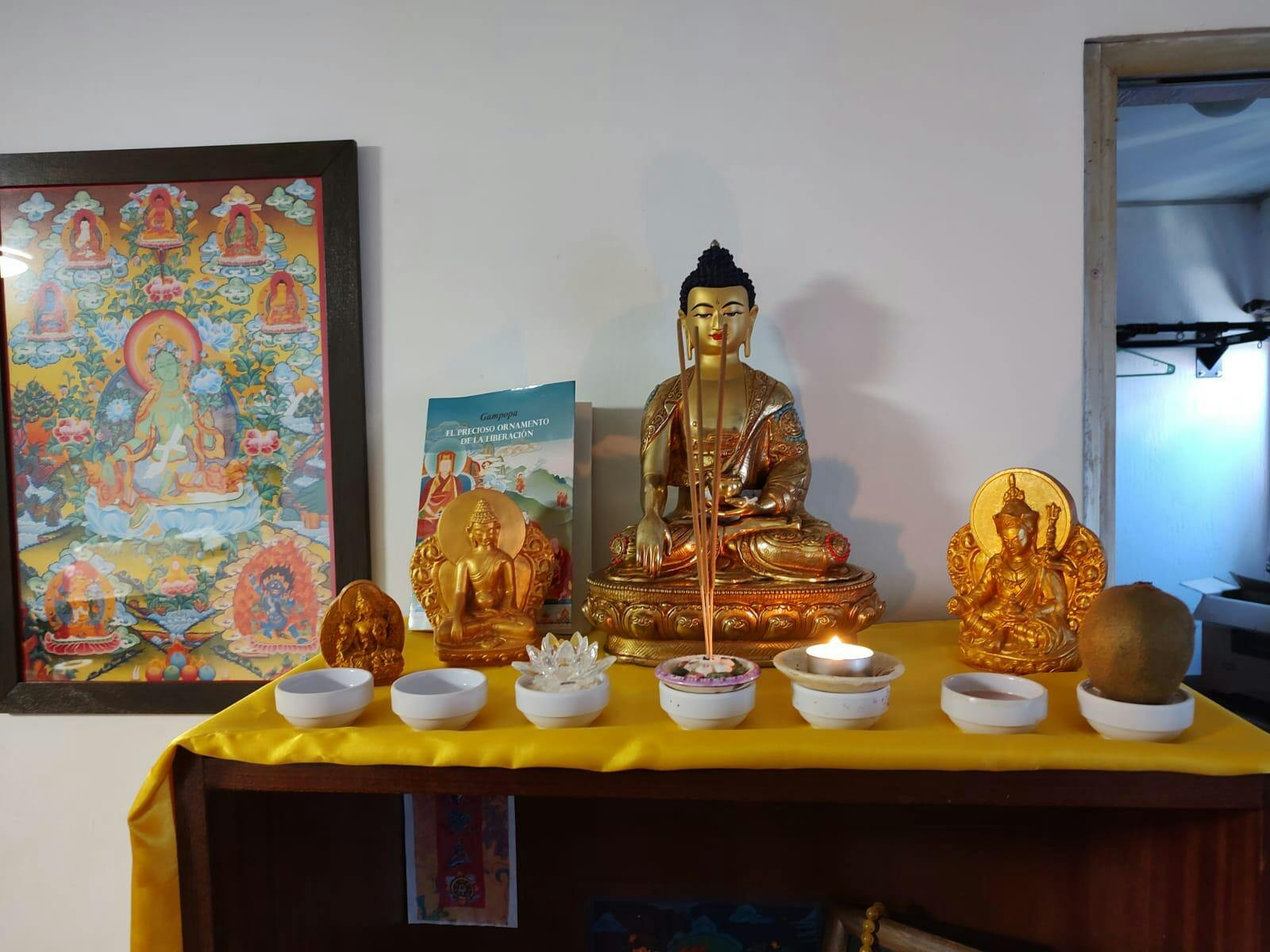
For this reason, Vajradhara images may be placed in meditation spaces, Buddhist shrines, temples, and personal sacred spaces according to the practitioner's tradition.
Vajradhara in Nepalese Buddhist Art
Nepal has a particularly rich history of Buddhist sculpture, especially within the Newar artistic traditions of the Kathmandu Valley.
Nepalese Vajrayana art is renowned for its intricate metal sculpture, detailed ornamentation, expressive faces, elaborate crowns, lotus bases, and carefully rendered ritual attributes.
A traditionally crafted Vajradhara statue can therefore carry two dimensions of meaning at once. It represents an important figure in Vajrayana Buddhism while also preserving a living artistic tradition that has developed in the Himalayan region over centuries.
This is why a finely made Vajradhara sculpture is not merely decorative. The craftsmanship itself becomes part of the experience of encountering the sacred image.
How to Recognize Vajradhara
If you encounter an unfamiliar Himalayan Buddhist statue, several features can help identify Vajradhara.
- Dark blue body
- Peaceful Buddha-like expression
- Rich Sambhogakaya-style ornaments
- Seated meditation posture
- Vajra held in the right hand
- Bell held in the left hand
- Hands crossed at the heart
- Vajra and bell forming the characteristic crossed gesture
Among these features, the crossed vajra and bell at the heart are especially distinctive.
Vajradhara and the Deeper Meaning of Enlightenment
Perhaps the most beautiful way to understand Vajradhara is not as a distant supernatural figure, but as a representation of what Buddhist practice ultimately points toward.
The vajra reminds us of what is indestructible.
The bell reminds us of wisdom.
The crossed hands bring these principles together.
His blue form suggests depth and vastness.
His peaceful expression points toward inner freedom.
His ornaments represent a form of enlightened manifestation rather than ordinary worldly luxury.
Taken together, these elements create a visual teaching about the nature of awakening.
Vajradhara asks us to look beyond appearances and recognize that wisdom and compassionate action belong together.
Final Thoughts
Vajradhara occupies a unique place in the world of Himalayan Buddhism. As the primordial Buddha associated with the Dharmakaya in several Tibetan Buddhist traditions, he represents the profound nature of enlightenment and stands at the heart of important Vajrayana lineages.
His image may appear quiet and serene, but the symbolism within it is remarkably deep. The vajra and bell, the crossed hands, the dark blue body, the jeweled ornaments, and the meditative posture each contribute to a visual language centered on wisdom, method, emptiness, and awakened awareness.
Perhaps that is what makes Vajradhara such a compelling figure in Buddhist art. His statue does not simply ask us to admire an image. It invites us to pause, look carefully, and contemplate what the symbols are trying to teach.
And behind the gold, copper, jewels, and intricate craftsmanship lies a much simpler message:
Wisdom and compassionate action must come together on the path to awakening.


Share:
Śūnyatā in Buddhism: Understanding Buddhist Emptiness
Je Tsongkhapa: Life, Teachings, Philosophy & Legacy