
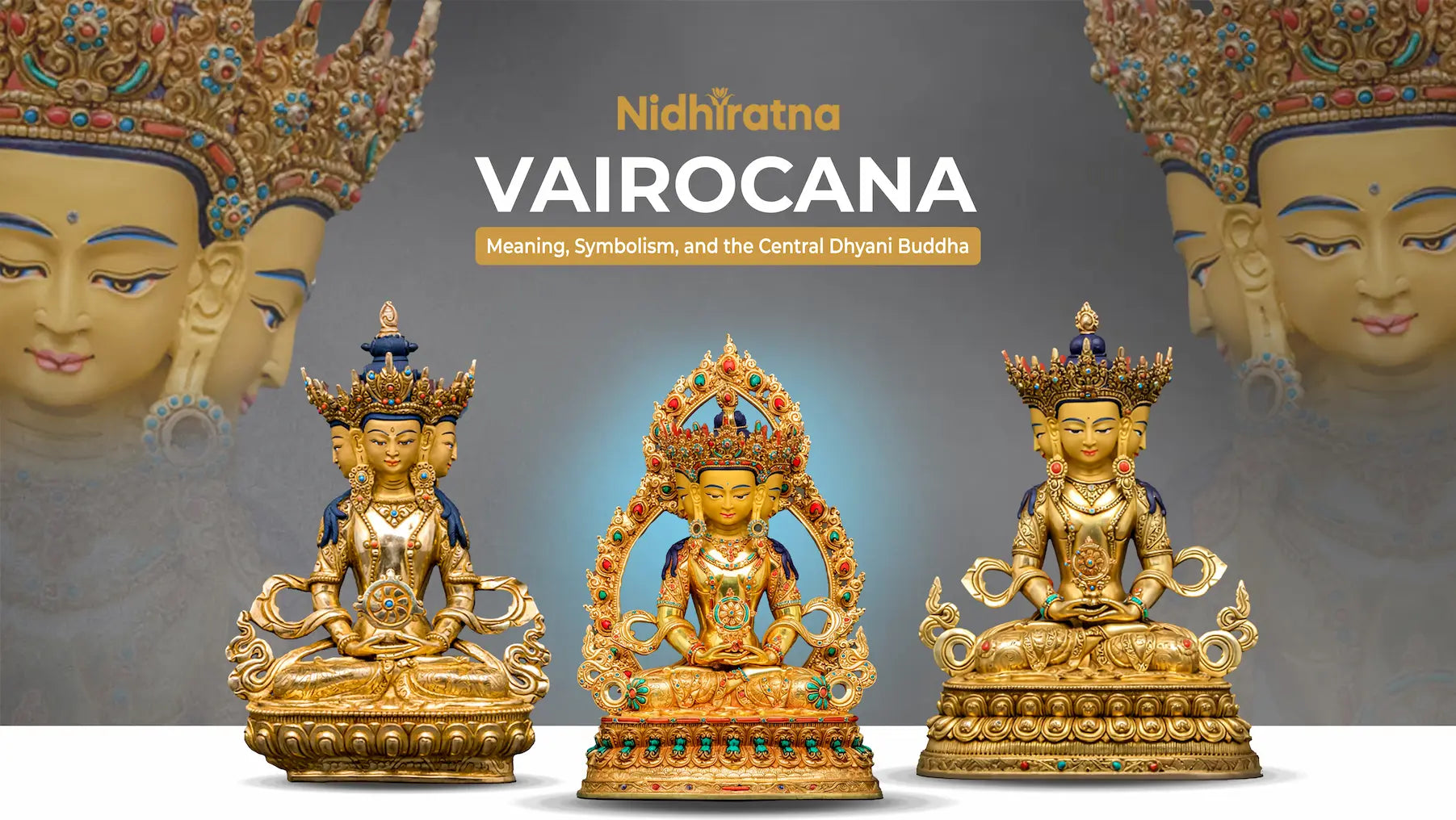
Vairocana: Meaning, Symbolism, and the Central Dhyani Buddha in Vajrayana Buddhism
The name Vairocana, “the Radiant One,” evokes something profoundly active. It literally translates to “one who shines out.” Within the Avatamsaka Sutra, the entire cosmos is believed to be present within him. Endless realms of reality radiate from this central figure in all directions, without interruption.
Within Buddhist tradition, Vairocana is recognized as the Dharmakaya, the Buddha's pure truth body. He represents the ultimate truth, existing entirely beyond form. Vairocana depicts the nature of purity and enlightenment that comes without any effort and that one can find within oneself.
There are distinct regional interpretations of his representation within different Buddhist societies. He is regarded as the cosmic Buddha within the core of the teachings in Vajrayana. He offers us a feeling of stability in our meditation and other religious artworks as he forms the center in most cases of mandalas and paintings. He signifies the awakening itself, and hence his importance cannot be questioned.
Key Iconographic Features of Vairocana Buddha
1. Face and Serene Expression
The calm, single-faced, or four-faced deity has the serene nature of an enlightened individual. The tranquil face he possesses is a symbol of the peace, which appears brighter due to his total understanding.
2. Color and Body Features
Vairocana is associated with white, representing purity, universal knowledge, and the transition from ignorance to enlightenment. He is also a representation of total reality since white is a mixture of all colors. He is part of esoteric mandalas, where he has a four-armed form paired with Ḍākinīs (female energy deities), especially seen in the Vajracakra and Hṛdayacakra.
3. Lotus Throne
Vairocana is seated in the full lotus or vajra position. His golden lotus, his throne in his celestial form, represents his deep link with the universe.
4. Mudras
In total, there are three hand gestures used by Vairocana that reflect various emotions such as compassion, wisdom, and protection. The Dhyana Mudra helps in enhancing these mudras since it symbolizes the ability to bless all living things within the universe. Dharmachakra Mudra is one of the hand gestures used by Vairocana for teaching. The Vairocana Buddha can also be shown in his typical position, the Bodhyagri Mudra, or "wisdom-fist" posture, involving the holding of the fingers of one hand with the other hand.
5. Ritual Objects
The ritual objects like skull-bowl, staff (khaṭvāṅga) and small drum (ḍamaru) do not usually belong to Vairocana when he is depicted as the calm Buddha in the center. However, these ritual objects are more likely to be connected with Vairocana when he appears in his tantric or esoteric forms, particularly the forms that occur in advanced stages of Vajrayana Buddhism.
Vairocana as the Central Dhyani Buddha of the Mandala
The significance of Vairocana in the practices of Vajrayana Buddhism within the context of the Tantras lies in his location in the mandala’s center, representing the center of the cosmos. Mandalas act as divine diagrams of the universe and are depicted as the center where all opposing forces, such as form and emptiness, physicality and spirituality, manifestation and non-manifestation, converge into one single existence.
|
Poison |
Wisdom |
Dhyani Buddha |
|
Ignorance |
Dharmadhatu Wisdom |
Vairocana |
|
Anger |
Mirror-like Wisdom |
Aksobhya |
|
Pride |
Equality Wisdom |
Ratnasambhava |
|
Desire |
Discriminating Wisdom |
Amitabha |
|
Jealousy |
All-accomplishing Wisdom |
Amoghasiddhi |
He is accompanied by Akshobhya in the East, Ratnasambhava in the South, Amitabha in the West, and Amoghasiddhi in the North. By residing at the center, Vairocana is the cosmic origin of all Buddhas, wisdom, and energy that empower followers to continue on their journey.
Mantras, Pure Lands, and Divine Consorts of Vairocana
The act of contemplating Vairocana is usually considered looking within oneself to reach the essence of one’s inner self. He is believed to embody the radiating Buddha nature that already exists in each person regardless of the fact that he/she is blinded by confusion or ignorance. The figure of Vairocana serves as an inspiration to people because it reminds them that enlightenment does not lie somewhere else; it is right inside them, at the core of their hearts.
“Om Vairocana Om” is the mantra associated with him that must be recited either 21 or 108 times per day for spiritual blessings and wisdom. The seed syllable “Om” represents his pure, enlightened essence and universal presence. Vairocana is also believed to reside in the Akanistha Ghanavyuha Pure Land, the highest and most refined spiritual realm located at the symbolic center of the cosmos.
In the Vajrayana tradition, Vairocana’s principal consort is Dhatvishvari, also known by names such as Akashadhatvishvari, Locana, White Tara, or Sudarshana. She stands for the immaculacy of the infinite space as well as for the union of her wisdom and emptiness. Often portrayed sitting on a lion’s back, she embodies such qualities as fearlessness, courage, and bravery.
Modern Interpretation of Vairocana
Vairocana Buddha’s teachings present the best possible means of solving modern issues of our times. He brings forward emptiness and the interdependent nature of all beings and objects, suggesting that all objects have temporary existence. As per his philosophy, one has power over how to endure the changes happening in one's life and, accordingly, develop wisdom and compassion.
Vairocana, who is the instructor of all, stands as an eternal source of wisdom. His advice on emptiness and interconnection teaches practitioners how to free themselves from their bondages and comprehend that all things within life are temporary. His lifestyle teaches us the path that leads to harmony with the rhythm of nature and grants us liberation from suffering as we find peace of mind and enlightenment within ourselves.
Vairocana Statue Collection at Nidhiratna
Nidhiratna has collections of Vairocana statues that together bring a unique aura of serene majesty and intricate splendor, no matter where you put them. His energy signifies the infinite wisdom beyond form and illusion, sitting in complete stillness on an exquisite lotus base.
With hands held in the Dharmachakra Mudra, the statue represents the profound energy of spiritual learning in action. At Nidhiratna, you can shop for the radiant golden face of the Vairochana Buddha. It comes with a full set featuring the magnificent crown, delicate jewels, and a designed robe handcrafted by our Newari artisans. They have shown their legacy in every contour and design of the statue while crafting it with traditional gilding and wax processes. It can be used to adorn a shrine, meditation area, or collection of sacred objects.
Conclusion
Essentially, Vairocana is the deeper core of the entire universe of esoteric Buddhism. He is the shining center of the mandala and the Dharmakaya itself, the final reality behind everything. He can be interpreted as the timeless presence of the Dharma and the original, primordial Buddha. His existence teaches that despite the myriad differences and disorder in the world, there is an absolute reality where all is one in wisdom, purity, and enlightenment.
FAQs
1. Why is Vairocana Buddha a Central Dhyani Buddha?
Vairocana is the central figure, source, and illuminator of the Five Dhyani (Wisdom Buddhas). He is a cosmic Buddha who represents the universal aspect of liberation, the cosmic teachings of Buddhahood, and the pure Dharmakaya (truth body).
2. What are his visual characteristics?
Vairocana is white in color and seated in a meditation posture on a lotus; he frequently wears monastic clothes. However, in other traditions like the Shingon school, he wears a princely crown with artistic jewelry.


Share:
Understanding Asanas and Mudras in Buddhist Statues: Meaning and Symbolism
21 Taras Practice and Meaning: Complete Tibetan Buddhist Guide