

Palden Lhamo is the sole female Dharmapalas among the Eight mentioned in ancient Vajrayana Buddhism. In Sanskrit, she is also known as Shri Devi, the protective deity of Buddhism. She serves as the main guardian of Tibet and the Dalai Lama lineage.
According to tradition, the First Dalai Lama saw her visions at the sacred Lhamo La-tso lake, where he had gone to meditate. She is regarded as an emanation of Goddess Kali believed to be the protector of the lineage. Her residence is traditionally associated with Chokorgyel Monastery.
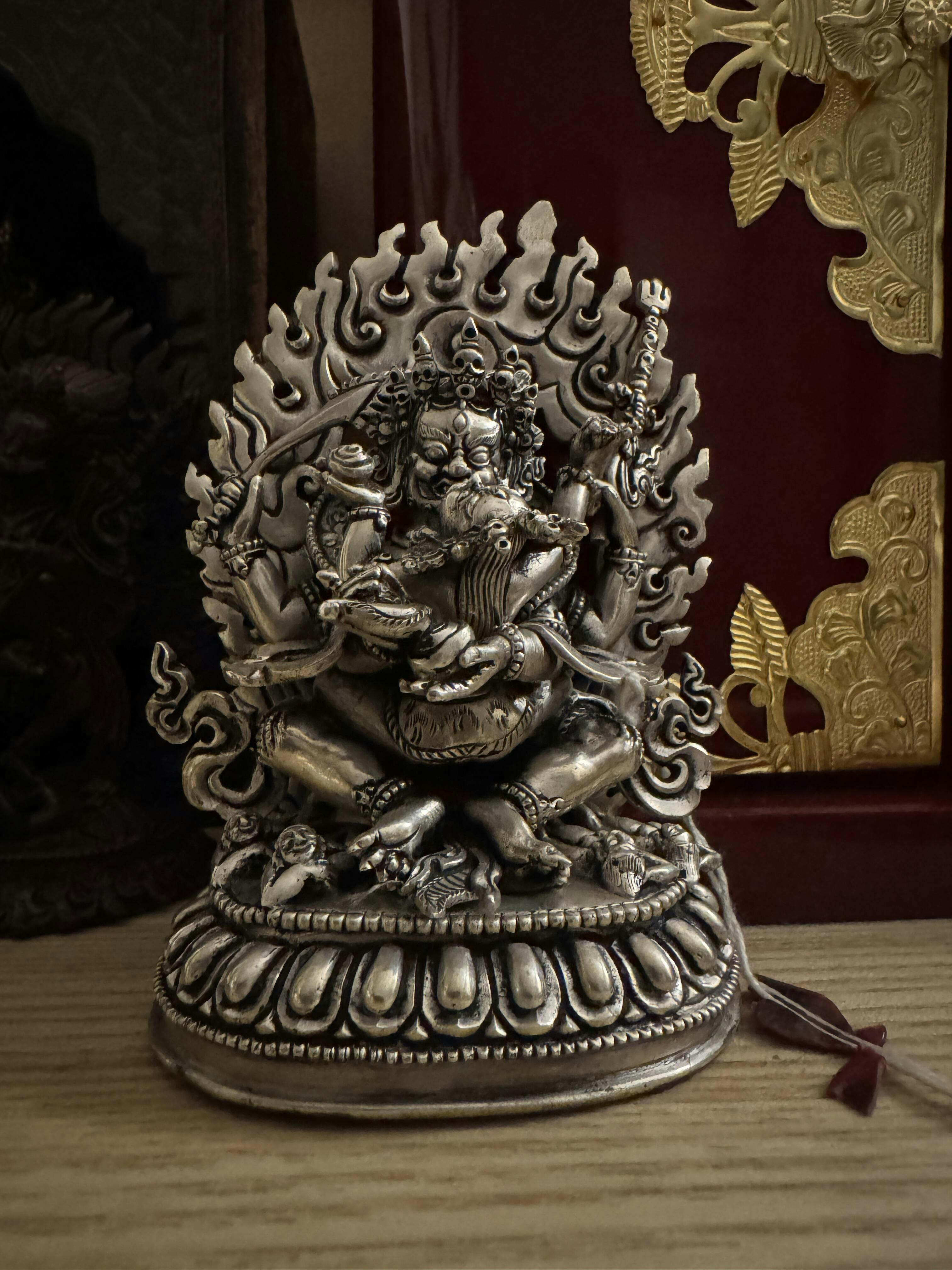
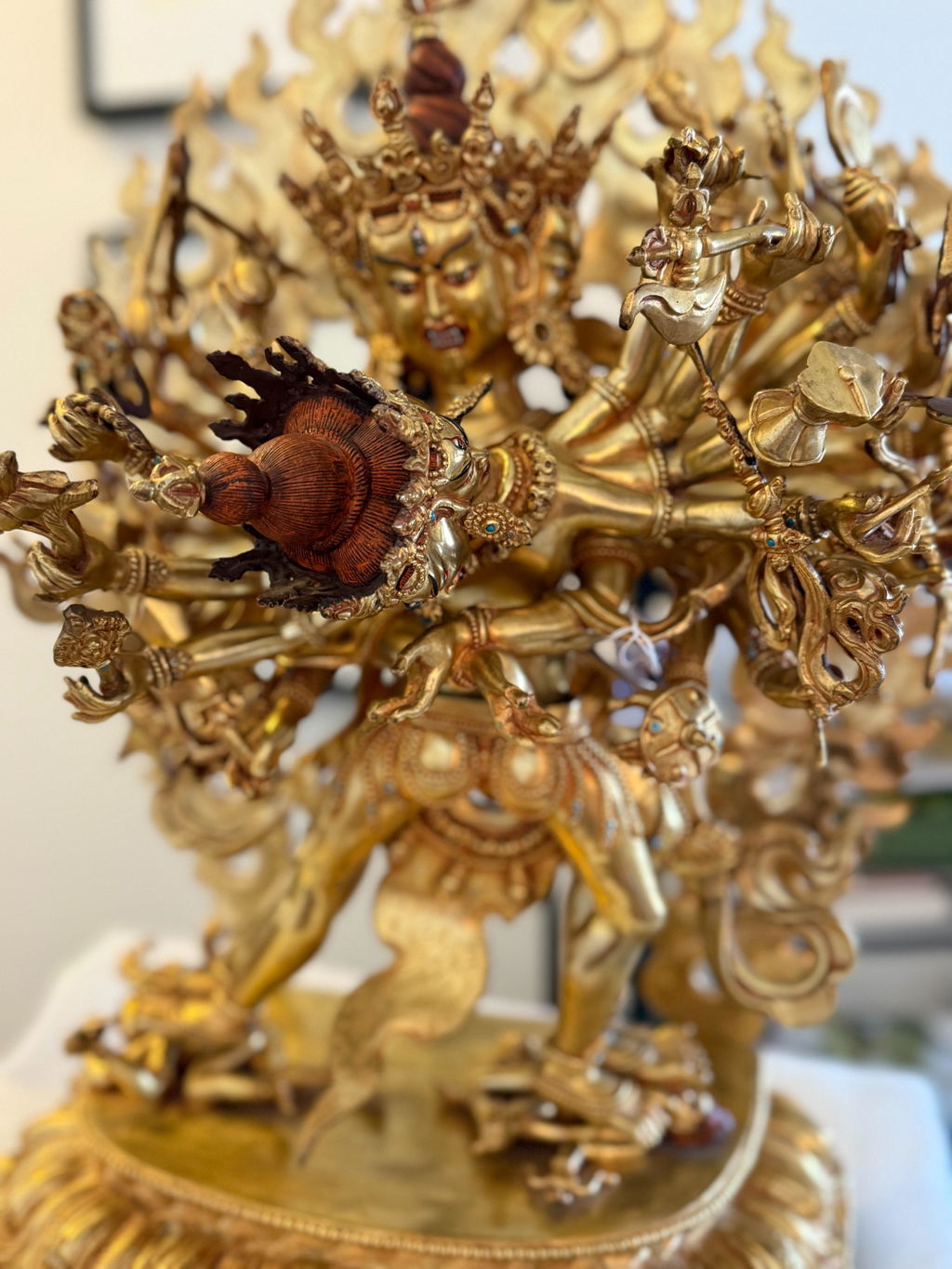
Palden Lhamo holds a unique position in the Tibetan spiritual hierarchy as mentor of the Gelug school. She is a fierce Dharmapala within the Vajrayana tradition, identifiable by her dark blue skin, fiery red hair, and a third eye that perceives past, present, and future.
Mystical Story of Palden Lhamo
According to ancient Buddhist stories, Palden Lhamo was married to the evil King of Lanka. She tried endlessly to turn him away from harming Buddhist.
When her efforts failed, and her son was destined to continue his father’s cruelty, Palden Lhamo took the extreme step of ending his life, symbolizing the sacrifice of personal attachment for the greater good.
When she fled king struck her mule with a poisoned arrow, but with her awakened power, she healed the wound. She transformed it into a third eye, allowing her to see the past, present, and future as she watched over the regions under her protection.
Following her escape, the Buddha empowered her to serve as a supreme protector of the Dharma. She took a solemn vow to safeguard Buddhist teachings and became the chief guardian of the Dalai Lama lineage, starting with the First Dalai Lama, Gendun Drup.
In Tibetan tradition, she became the principal guardian of the Dalai Lama lineage after the First Dalai Lama saw her visions at Lhamo La‑tso—the sacred oracle lake. The stories depict how she promised to protect the reincarnation lineage of the Dalai Lamas. It is also believed that regents have long turned to her for guidance in identifying the next Dalai Lama.
Iconography and Symbolism
Palden Lhamo has a fierce expression that symbolizes the highest form of protective, transformative energy in Tibetan Buddhism.
i) Rides Mule
She is most famously shown riding a mule across a sea of boiling blood. The sea of blood represents Samsara—the endless cycle of birth, death, and suffering. She rides through a sea of blood to show she can handle life's deepest pain and toughest emotions.
While a horse is easy to lead, she rides a stubborn mule to prove she has the strength to control a wild ego and turn our most difficult traits into something positive.
ii) Physical Features
Her physical features carry deep spiritual meanings. Her dark blue or black skin represents the infinite void (Sunyata) and her grounding in ultimate reality, beyond material illusions. The third eye on her forehead perceives the spiritual realm, symbolizing perfect wisdom and insight beyond the ego. The flaming halo—the Vajra flame of pure awareness—acts as a spiritual furnace that burns away delusion and purifies karmic obstacles.
iii) Weapons
Palden Lhamo holds a skull cup (kapala) that contains the “blood of the four Maras.” She is believed to drink from which means she swallows negative energies for the sake of wisdom. Her weapons, such as the sandalwood club or sword, are the other symbolic tools used to sever ignorance and attachments. It helps us cut through the lies we tell ourselves frequently and find the ultimate truth in the form of devotion.
iv) Fierce Vow
Palden Lhamo has a fierce vow to protect the Dharma. She gave up her own peace and happiness to make sure the Buddha’s teachings would survive. When the world is full of confusion and obstacles, her bold compassion becomes a spiritual wake-up call. Every detail of her appearance has a meaning; understanding it shall attract positive manifestations in one’s life, including peace and resentment.
Palden Lhamo as a Dharma Protector
As a Dharmapala, Palden Lhamo serves as a guardian of monasteries, sacred sites, the Buddha’s teachings, and devoted practitioners. She is often called upon to:
-
Shield against negative influences and obstacles
-
Protect spiritual vows and commitments
-
Help overcome fear, confusion, and inner resistance
-
Ensure the continuity and integrity of Buddhist teachings
She is also linked to karmic justice, maintaining balance and ethical order in spiritual life. Tibetan Buddhists celebrate Dharma Protector Day (Dharmapala Day) on the 29th day of each lunar month to honor her protective presence.
Deeper Spiritual Meaning
Palden Lhamo embodies the unstoppable feminine energy that guides one to awaken one's awareness. She shows that compassion is not always gentle—sometimes it comes in unexpected form, like it is bold, fearless. Her example encourages practitioners to possess similar courage and discipline and maintain faith to receive blessings in their spiritual journey.
Though her appearance is fearsome, her ultimate purpose is liberation. She stands with devotees who overcome challenges and obstacles through sincere dedication to the god. She guides and protects those genuinely committed to pursuing wisdom, insight, and enlightenment. Devotess can chant her mantras to evoke her presence in their life.
How to Chant Palden Lhamo’s Mantras?
One of the most widely recited mantras of Palden Lhamo (Śrī Devī) is:
OM SHRI DEVI HUM HUM PHAT PHAT SOHA
Devotees can sit relaxed and visualize the devi at their meditation space to make the most of the mantra chanting.
-
Choose a quiet space:
Before you begin, find yourself a peaceful spot at home that feels calm and clear. Whether it's a meditation room or just a chair by the window, make sure you can tune your inward attention and give your undivided energy to prayer in that space.
-
Set your intention:
Before chanting, take a moment to set your intention. Dedicate your practice to invoking Palden Lhamo’s presence into your life and let go of thoughts that can hold you back.
-
Posture:
Sit at ease with your back straight. You can place your hands in prayer position (Anjali Mudra) or on your lap.
-
Recitation
Recite it slowly and clearly, focusing on the sound and meaning. You may repeat it a set number of times, most preferably 108 times.
-
Visualization:
While chanting, visualize Palden Lhamo riding her mule, radiating protective energy, and transforming obstacles into wisdom. You can also visualize her as she appears in her idol and Thangka paintings available at Nidhiratna.
-
Conclude with dedication:
After finishing, dedicate the merit of your practice to the well-being of all beings and the preservation of the Dharma.
Key Spiritual Lessons from Palden Lhamo’s Story
-
Compassion can be fierce: True care can be masked by fierce appearance, so do not judge by how it seems at first.
-
Letting go is essential: Spiritual liberation comes when one is free from personal attachment.
-
Transformation can come when you least expect it: Often, it’s the moments that feel the most threatening or difficult that act as a spiritual catalyst.
-
Face ignorance boldly: Awakening happens when you face your fears boldly and stay grounded to see the truth, even when things feel a little overwhelming.
-
Protection is for the greater good: Spiritual power is meant to safeguard authentic teachings and ethical leadership.
-
Appearances can be deceiving: What seems fearsome can actually embody deep care and enlightened intent.
Shop with Nidhiratna
At Nidhiratna, we are dedicated to bringing the timeless beauty and spiritual essence of Nepalese craftsmanship to your home. Our hand‑crafted Buddhist idols and sacred statues, thangka paintings, idols, and spiritual items are now on sale at our website.
Feel inspired by the fierce protection and sacred symbolism of Palden Lhamo? If you’d like to learn more about authentic statues or spiritual artworks, we’re here to help.
Have questions or need guidance? Contact us today to connect with our team.
FAQs
1. What does the wrathful appearance of Palden Lhamo signify?
Although she appears fearsome, this wrathful form represents a powerful, compassionate energy—like a mother whose fierce force overcomes ego, ignorance, and any barriers to spiritual awakening.
2. What does the mount of Palden Lhamo signify?
Her mule carries deep symbolic meaning, representing the ability to navigate suffering, transform the stubbornness of human ignorance into spiritual growth, and let go of attachments.
3. What is her connection to the Dalai Lama lineage?
She is believed to protect the reincarnation lineage of the Dalai Lamas. Regents traditionally consult her for guidance when identifying the next Dalai Lama.


Share:
Red Dakini Kurukulla: The Magnetizing Goddess of Power and Attraction
Handicrafts in Nepal: Cultural Pride, Artistic Legacy & Timeless Beauty