

Guru Rinpoche: The Eternal Guide Who Transforms Darkness into Light
Guru Rinpoche, or Padmasambhava - the "Precious Master" - is one of the few Hindu-revered figures across the entire Himalayan spiritual world. To millions of devotees, including Nepalese, Tibetans, Bhutanese, and those from the sun country, Guru Rinpoche's statue is no mere work of art but rather an active presence of enlightenment guiding mankind from ignorance into the light.
This statue representing Guru Rinpoche is not a holy sculpture; it is an eternal witness that states wisdom and compassion will dissolve the darkest suffering, and transformation is possible for every being.
What we are about to uncover with this timeless statue are wonders, meanings, transformations, arts, and teachings.
Who Is Guru Rinpoche?
Guru Rinpoche (Padmasambhava) is one of the semi-legendary figures of the 8th century credited with introducing tantric Buddhism to Tibet. In Tibetan Buddhism, he is often referred to as the "Second Buddha"; for while Shakyamuni Buddha preached the sutra path, Guru Padmasambhava is regarded as the master of the tantra path, the incarnation of the guru principle.
His name is deeply symbolic: Padma, meaning “Lotus,” and Sambhava, meaning “Born From” Legends say he was born from a lotus flower in the land of Oḍḍiyāna, signifying his extraordinary and ever-awakened nature from the very commencement.
The life story of Guru Rinpoche holds great importance for a fully comprehensive understanding of Guru Rinpoche itself, the energies it embodies, and the intention behind it.
Birth Story & Early Life
According to the hagiographies' sources, Guru Rinpoche was born in Oḍḍiyāna (often associated with the Swat Valley) as a fully awakened being, emerging from a lotus flower. The fact of his miraculous birth even hints at his being not merely a historical teacher, but rather the embodiment of primordial wisdom.
It is said that even before this birth, the king of Oḍḍiyāna, Indrabhuti, had foreseen his birth and that past Buddhas had predicted this master. During his youth, Guru Rinpoche was said to have gained instructions in spirituality and perfected the teachings in both sutra and tantra. Some texts say that he underwent advanced practices while developing the 'rainbow body'.
This early life story is the basis of why Guru Rinpoche images are often depicted with elements of lotus, bright robes, and intentional "master teacher" postures.
Spiritual Education and Mastery
Guru Rinpoche's spiritual training was inextricably intertwined with the mastery of the methods of tantra, guru devotion, and many other practices. Buddha Shakyamuni transmitted the sutra vehicle, while the mantra and tantra traditions are considered to be the great carriers, in the Himalayas, in perfect harmony with that.
The traditional biography describes the way he gained the rainbow-body of transference, in which he transformed his human bodily structure into a light symbol of total realisation.
This statuary form primarily reflects the features: khaṭvāṅga, kapāla, and possessing jewels, which evoke his mastery over subtle energies, impermanence, and the transformation of affliction into awakening.
The Prophecy & Divine Mission
The life of Guru Rinpoche was not just entirely sustained by personal mastery but also included some measure of execution of a cosmic task. Numerous sutras and tantras, indeed, are said to give predictions about his coming-forth and his eventual manifestation for the purpose of propagating the Dharma when sentient beings fell into decline.
His mission: to tame obstinate spirits and local deities of the land called Tibet, to found Buddhism in such an unchanging country, and to disclose treasure-teachings-terma-bequeathed to future generations.
Thus, the invocation of Guru Rinpoche transforms from a purely decorative item into an emblem of this mission: the transformation of darkness, ignorance, fear, and affliction into light awareness, compassion, and liberation.
Journey to Tibet & Historical Context
Around the 8th century, the king of Tibet, Trisong Detsen, invited Guru Rinpoche to develop the first Buddhist monastery at Samye Monastery and overcome all the obstacles that opposed the introduction of the Dharma there.
In fact, despite Guru Rinpoche’s place in myth and legend, he, from a historical and cultural perspective, is mighty: he is generally regarded as the founder of the "inner" tradition of Tibetan Buddhism known as the Vajrayāna, and the principle of the guru remains central.
Install the figure of Guru Rinpoche, and you bring the rich Himalayan heritage of historical culture, mythic power, and living spiritual tradition into your space.
Taming Demons & Subduing Spirits
One of the most interesting aspects of the story of Guru Rinpoche is the one involving the subjugation of local deities, demons and evil spirits in attempts to block Buddhism from spreading.
Many thangkas and statues depict him in a victorious posture, standing or seated in victory against darkness, an archetype for a symbolic gesture of turning hostile forces into Dharma protectors. Guru Rinpoche's representation thus becomes more than just an image to devote to-it becomes a hymn of inner alchemy. It transforms: conflict into compassion, fear into courage, ignorance into insight.
In practical spirituality, this means an unforgettable image created by a Guru Rinpoche statue: disempowered energies around you (inside or outside) can be turned to a different destiny. His image says: "Light can emerge."
The Eight Manifestations of Guru Rinpoche
To teach and protect beings according to need, Guru Rinpoche took on form in the following eight manifestations:
-
Guru Tsokye Dorje (Lotus-Born Child): Brilliant and youthful, has an inherent purity and the wisdom of the primordial.
-
Guru Pema Gyalpo (Lotus King): A regal and authoritative figure who symbolizes enlightened leadership, transforming enemies into friends.
-
Guru Nyima Özer (Rays of the Sun): Fierce and illuminating, it represents wisdom that dispels the darkness of ignorance.
-
Guru Loden Chokse (Supreme Knowledge Holder): Scholarly, integrating worldly and spiritual wisdom.
-
Guru Padmasambhava(Principal Manifestation): The historical master who brought the Vajrayana teachings from India to Tibet.
-
Mahatma Shakya Sengé (Lion of the Shakyas): As a monk, he embodied a teaching on the monastic discipline as well as unyielding commitment.
-
Guru Sengé Dradrok (Roaring Lion): Determined teacher through whose roar all doubts vanish in truth.
-
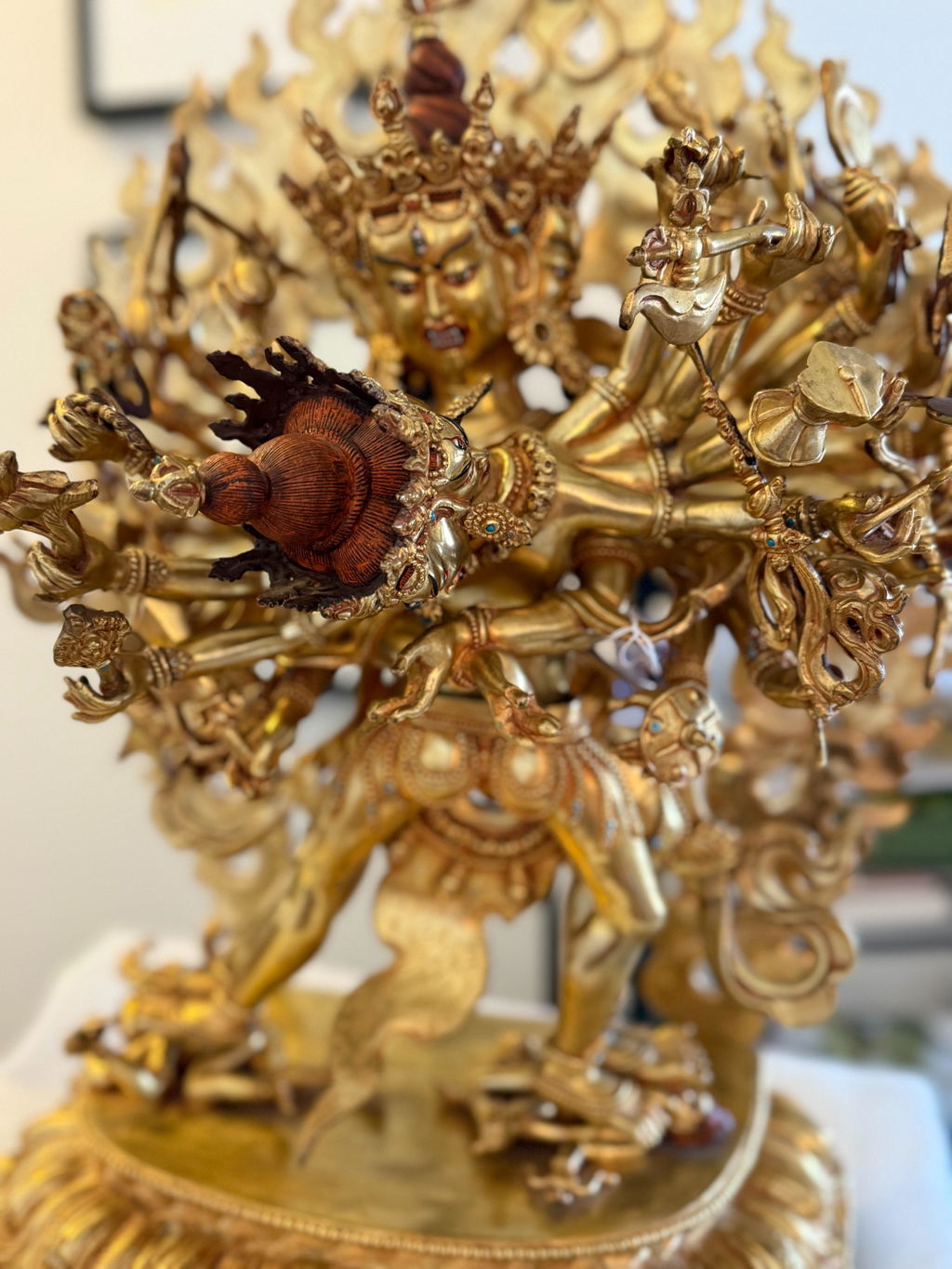
Guru Dorje Drolo (Wrathful Vajra): Extremely wrathful form, bursting through the last barriers of fierce compassion.
Every manifestation bears iconographic attributes and comes in the forms of statues and thangkas. A Guru Rinpoche statue may be in the form of Dorje Drolö, which is wrathful, or of Pema Gyalpo, royal, and this is dependent on the blessing or ritual being sought. Recognising this richness helps deepen one's connection to the statue.
We at Nidhiratna can help you bring the wisdom and light of Guru Rinpoche into your home. Contact us to inquire about authentic statues, sizes, and custom options.
Guru Rinpoche’s Core Teachings
What the living spiritual presence Guru Rinpoche becomes is not just a figure of myth, but through imparting his teachings. Among the major tenets:
-
Guru devotion: The guru is not merely a teacher but the living embodiment of the awakened mind. As the tradition states: "Mind itself is Padmasambhava; there is no practice or meditation apart from that."
-
Tantric practice: Getting the message from Guru Rinpoche that everything, including affliction, emotion, and sensuality, should be turned onto the Vajrayāna path, not away from it.
-
Treasure teachings (terma): He buried teachings, expecting them to be discovered in later ages and thus keeping the Dharma alive over time.
-
Fearless confrontation with one's inner demons: Rather than running away from darkness, one faces and transforms it, as is evident in the story of spirit-taming.
-
Integration of wisdom and compassion: The image often shows the deity holding a vajra (representing wisdom) and a skull cup or staff (representing transformation and compassion).
In seeking out a Guru Rinpoche statue, we not only commemorate a historical figure, but also literally share the living teachings that embody this meaning: devotion, transformation, fearlessness, and integration.
Statue Iconography & Symbolism

This statue is a symbol of the great generosity of meaning. It contains all-in calm. Guru Rinpoche's statue is rich in symbolic detail. Each of these elements aids in deepening one's practice and appreciation:
-
Lotus-throne or lotus birth motif: Purity - fails to arise externally from mud.
-
Eagle-feathered lotus hat: This is one of his most used hats; it signifies that he has mastered everything that has rank and ego, and also that he is the tantric master.
-
Khaṭvāṅga staff: This usually has either three heads, representing the three poisons-ignorance, attachment, and aversion or features the trident symbolising the three channels. This staff represents his mastery and the union of wisdom and method.
-
Vajra (dorje) in right hand: Unshakable, indestructible awakened mind.
-
Skull-cup (khaṭvā) in left hand: Symbol of transformation of death, impermanence, and worldly forms into dharmic wisdom.
-
Wrathful vs peaceful expression: One side is calm and placid, while the other shows wrath. Both represent the same awakened nature encountering beings in whatever way is effective.
-
Jewelled ornaments and robes: indicate enlightened mastery; his the king of yogic status, transcending dualities, unlike a hair-shirt hermit.
Thus, placing a Guru Rinpoche statue is not merely ornamenting; it is a siddhi-laden embodiment of his waking presence and potential.
Transformative Power Principles
How does the Guru Rinpoche statue serve our interests? Here is a look at a few transformative power principles:
-
Focusing on a statue aligns one with the awakened energy: In focusing inward toward a statue, one aligns oneself with the awakened presence of Guru Rinpoche. This increases the influence of devotion and connection to the statue.
-
A Transformational Mirror: The statue communicates to our inner lives—what we think of as darkness (fear, anger, ignorance) can always be transformed into light (compassion, wisdom).
-
Having a tangible reminder of sacredness in the fabric of everyday life: Its presence gives life to spiritual possibility while the world is buzzing with activity.
-
Accessing the inspiring lineage of living tradition: Guru Rinpoche is directly connected to the past and extends forward into the future through masters, practice lineages, and statues.
-
Space-clearing and protective energy: In Himalayan culture, an image of Guru Rinpoche is considered auspicious because being within its depiction is believed to carry the idea that obstructive forces can be pacified or transformed into protectors.
By introducing a Guru Rinpoche statue into your space, you can really channel these transformative principles, making them a reality rather than just ideas.
Conclusion
In the life, legend, and living presence of Guru Rinpoche, we've seen that Guru Rinpoche statues transcend the category of mere ornaments. It serves as an embodiment of the awakened mind, a vessel of transformation, a link to living lineage, and a practical tool for spiritual deepening.
From his lotus-born origin and cosmic mission through taming demon forces and establishing Buddhism in Tibet, to his eight manifestations and teachings that endure, Guru Rinpoche is ever inviting us to turn from paths of darkness into light, fear into courage, and ignorance into insight.
If you wish to bring this energy into your space, think about the various options available at Nidhiratna, which is an e-commerce website for buying and selling statues of different Buddhas (including Guru Rinpoche) around the world. A carefully chosen statue from Nidhiratna could become your spiritual companion and guide.
Share:
Green Tara and White Tara: Sacred Goddesses of Protection, Hope and Enlightenment
8 Bodhisattvas in Vajrayana Buddhism: Meaning, Significance, and Spiritual Benefits