

Yidam Kalachakra: Meaning of the Tantric Deity in Vajrayana Buddhism

Yidam Kalachakra is one of the most profound and advanced tantric deities within Vajrayana Buddhism. Known as the Wheel of Time, Kalachakra represents a complete spiritual system that explains the nature of reality, time, consciousness, and enlightenment. Rather than being a creator deity, Kalachakra is understood as an enlightened manifestation of the awakened mind that guides practitioners toward liberation from cyclic existence.
The Kalachakra tradition is preserved within Tibetan Buddhism and is considered part of the highest yoga tantra teachings, requiring deep study, guidance, and initiation from qualified masters.
Meaning and Symbolism of Yidam Kalachakra
In Vajrayana Buddhism, a Yidam is a meditational deity used as a focus for advanced spiritual practice. The Yidam is not worshipped as an external god but is visualized as the enlightened nature of mind itself.
Kalachakra, as a Yidam, represents the purification of perception, in which ordinary experience is transformed into purified awareness free from ignorance and distortion. It embodies the transformation of everyday perception into awakened wisdom, allowing practitioners to recognize the sacred nature of all phenomena. Through this realization, Kalachakra signifies mastery over the cycles of time and karma, showing that conditioned existence operates through repeating patterns that can be understood and transcended. Ultimately, it points toward the realization of non-dual awareness, where the separation between self and reality dissolves into direct experience of the enlightened mind.

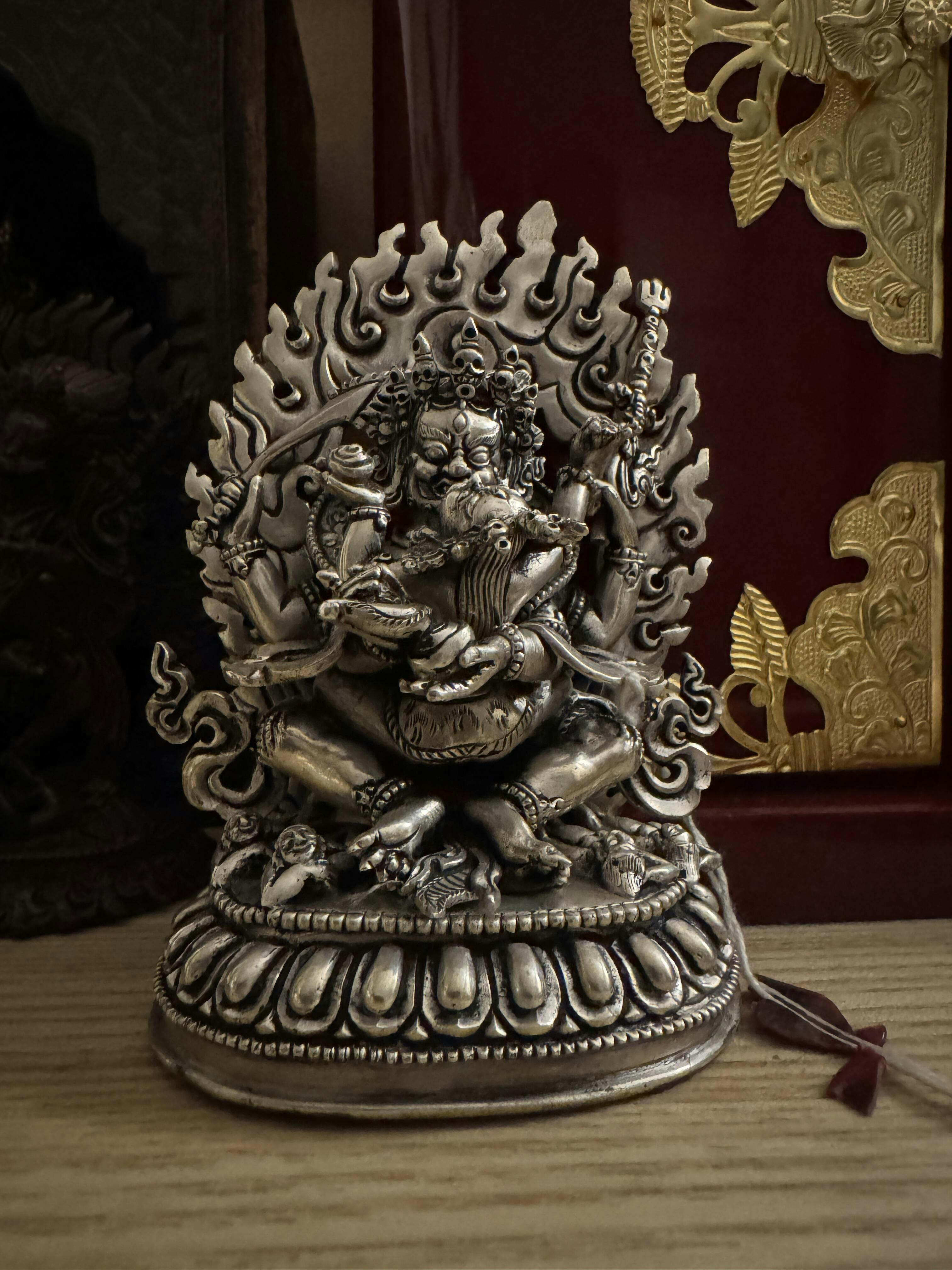
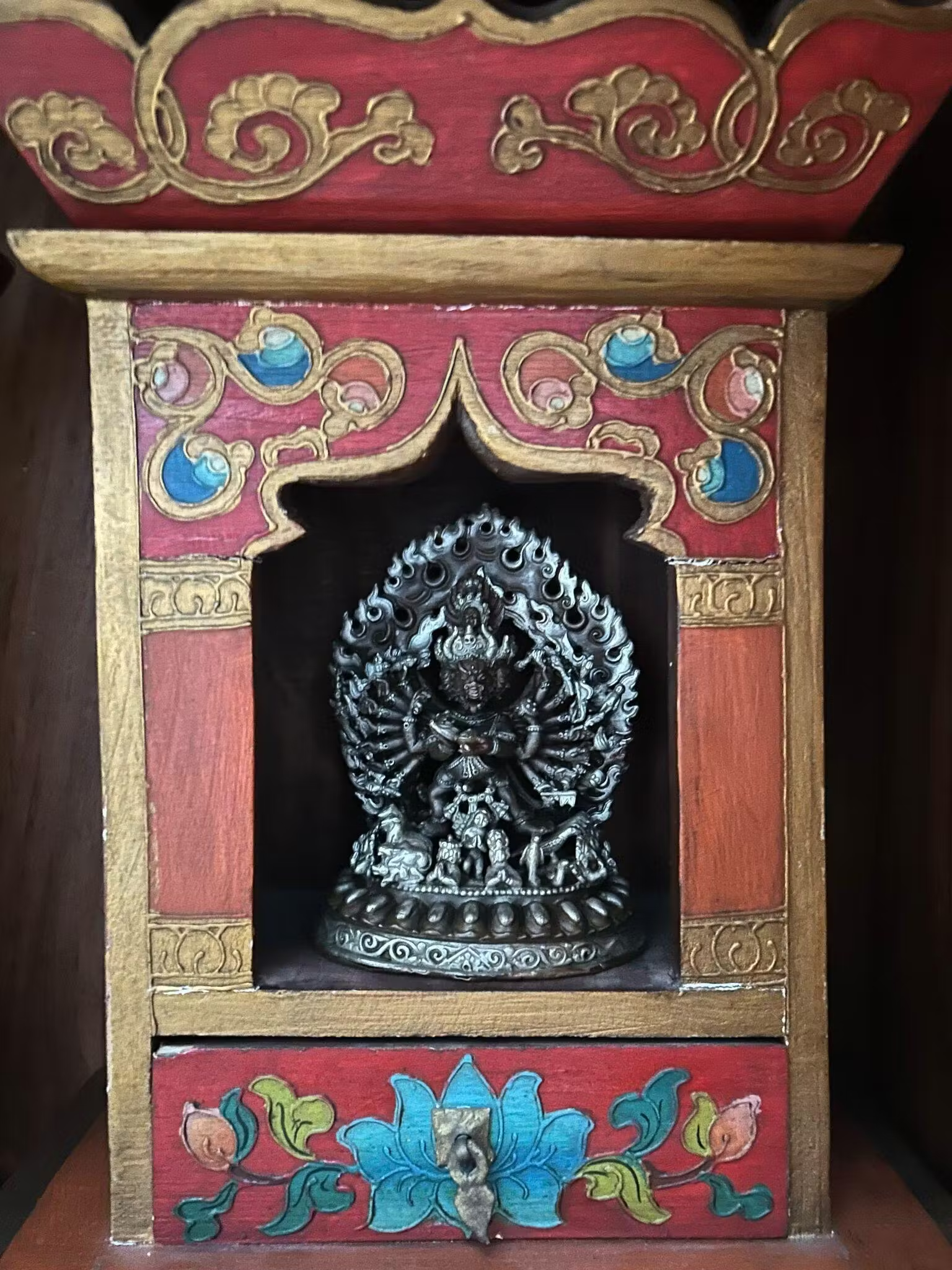
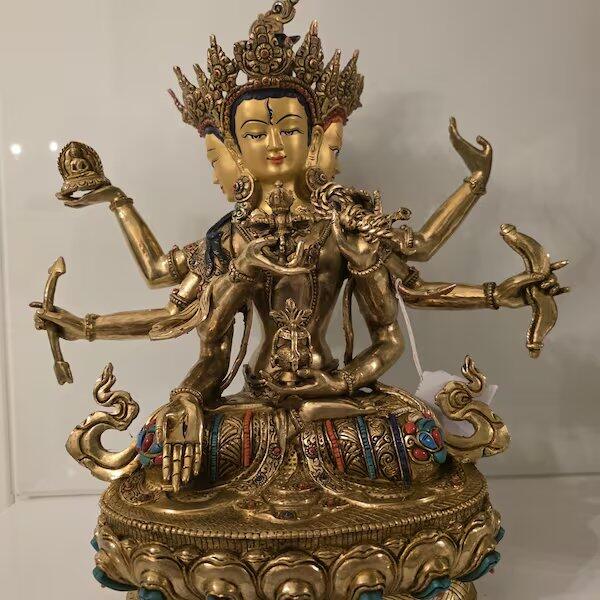
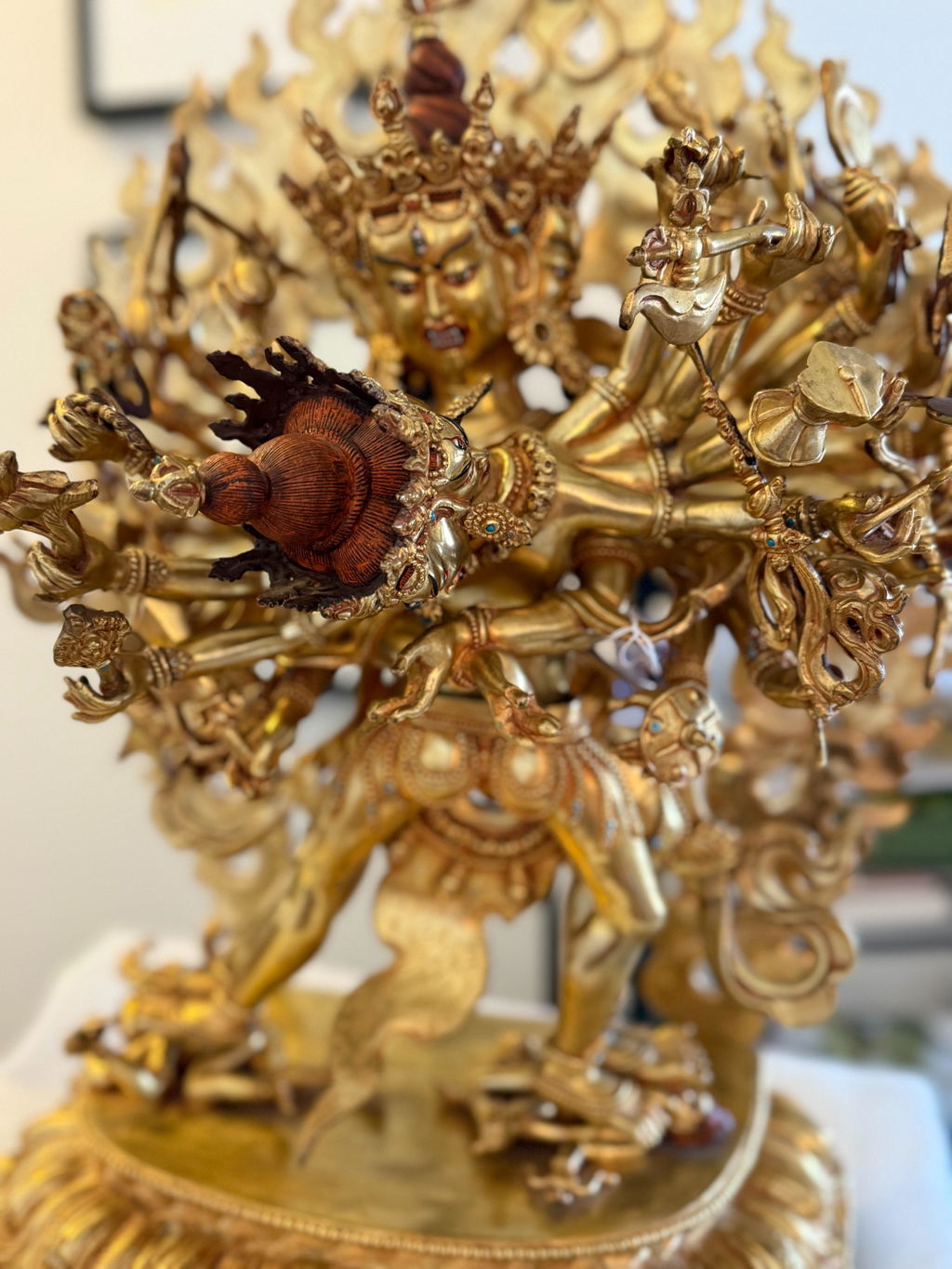
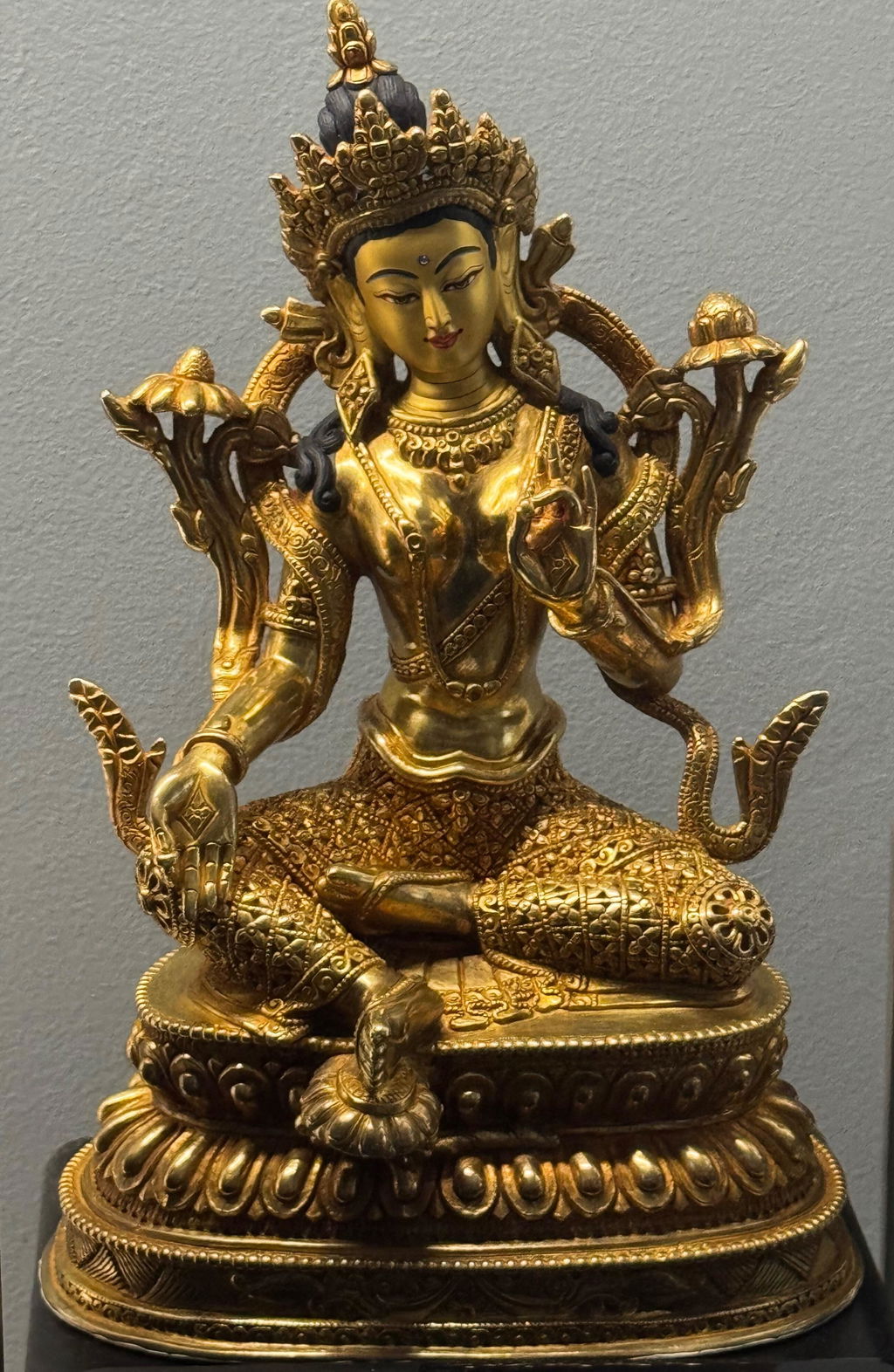
Click Here To View Our Kalachakra Statue
The term Kalachakra is derived from Sanskrit, where “Kala” means time and “Chakra” means wheel or cycle. Together, the term expresses the concept of the “Wheel of Time,” symbolizing the continuous movement and interdependence of all phenomena within cyclic existence.
History and Origin of Kalachakra Tantra
The origins of the Kalachakra Tantra are traditionally traced back to the mythical kingdom of Shambhala, and it is believed that these teachings were introduced into Tibet around the 11th century. According to Buddhist lore, the Buddha himself transmitted these teachings in a special form, though they remained highly esoteric for many centuries.
Over time, the Kalachakra system gained prominence within Tibetan Buddhism, especially when influential masters helped preserve and systematize its teachings. Among them, Tsongkhapa, the founder of the Gelug school, played a significant role in emphasizing the importance and structure of tantric practices within a disciplined philosophical framework, helping integrate Kalachakra into the broader Buddhist scholastic tradition.
Philosophical Foundations of Kalachakra
The Kalachakra Tantra stands out for its deep integration of Buddhist philosophy, cosmology, and spiritual psychology. It presents an intricate connection between the macrocosm of the universe and the microcosm of human experience, showing that external reality and inner consciousness are fundamentally interrelated.
It also explores the nature of reality itself, examining how perception is shaped by karmic patterns and mental imprints. Through this understanding, Kalachakra teaches that both the physical and spiritual realms are not separate but are expressions of the same underlying awareness. This non-dual perspective forms the philosophical foundation of the entire Kalachakra system.

Symbolism of Kalachakra
Kalachakra carries deep symbolic meaning that reflects both the outer universe and inner mind.
1. Wheel of Time
The wheel represents the endless cycles of:
- Birth and death
- Cause and effect
- Seasons and cosmic rhythms
- Mental and emotional patterns
It teaches that all phenomena arise and dissolve in cycles governed by karma.
2. Union of Wisdom and Method
Kalachakra is often depicted in union with his consort, representing Wisdom (prajna) and Skillful means (upaya). This union symbolizes non-duality, the realization that wisdom and compassion are inseparable.
3. Outer, Inner, and Alternative Realities
Kalachakra teachings are structured into three layers:
- Outer Kalachakra: The cosmos and universe
- Inner Kalachakra: The human body and subtle energies
- Alternative Kalachakra: The spiritual path to enlightenment
This structure shows the deep connection between the universe and the individual.
Kalachakra Mandala
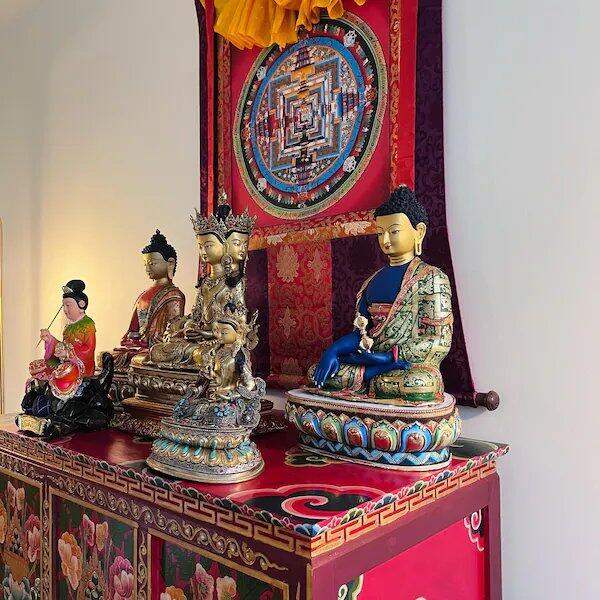
The Kalachakra Mandala is one of the most intricate symbolic diagrams in Tibetan Buddhism. It represents a sacred palace where the deity resides and functions as a complete map of spiritual transformation.
Rather than being a physical structure, the mandala represents stages of inner awakening. It guides the practitioner from ignorance to wisdom, confusion to clarity, and finally from samsara to liberation.
Traditionally, monks create sand mandalas with great precision and ritual devotion. Once completed, they are dismantled, symbolizing the impermanence of all conditioned phenomena and the importance of non-attachment.
Vishwamata: The Consort of Kalachakra

Vishwamata, also known as the “Mother of the Universe,” is the consort of Kalachakra and represents the essential principle of wisdom in Vajrayana Buddhism. In tantric symbolism, her presence is inseparable from Kalachakra, illustrating the profound non-dual union of wisdom (prajna) and method (upaya). While Kalachakra embodies skillful means, time, and enlightened activity, Vishwamata embodies the spacious awareness of wisdom that perceives the true nature of reality.
Together, Kalachakra and Vishwamata symbolize the complete state of enlightenment, where duality dissolves, and all distinctions between subject and object are transcended. This union is not understood in a literal sense but as a deep spiritual principle, showing that awakening arises through the integration of compassionate action and penetrating wisdom. In Kalachakra iconography and practice, this sacred union reflects the ultimate realization of non-dual awareness within Vajrayana Buddhism.
Role of Kalachakra in Vajrayana Practice
In Vajrayana Buddhism, Kalachakra is practiced as a Yidam meditation system centered on advanced visualization and inner transformation. Practitioners visualize the deity and the Kalachakra Mandala in detail, gradually transforming ordinary perception into pure, awakened awareness through Deity Yoga, where enlightened qualities are directly integrated into meditation experience.
A key aspect of this practice is the Six Yogas, a sequence of advanced meditation techniques focused on working with subtle body energies such as channels, winds, and consciousness. These practices are designed to harmonize body and mind, leading toward deeper realization and spiritual awakening. Alongside this, ritual practices are used as supportive methods, helping practitioners internalize teachings and bridge ordinary awareness with sacred understanding.
The Kalachakra Mandala also plays a central role, serving as both a symbolic representation of enlightened reality and a meditation tool. It reflects the deity, his pure realm, and the broader cosmology of Kalachakra teachings, guiding practitioners toward insight into the connection between outer universe and inner mind.
Due to its depth and complexity, Kalachakra practice is traditionally undertaken only after formal initiation from a qualified Vajrayana master.
Kalachakra in Modern Practice
In contemporary Buddhism, Kalachakra is widely understood as a profound message of global peace, environmental harmony, inner transformation, and psychological balance. Rather than being limited to ancient ritual or philosophy, the Kalachakra teachings are often viewed as deeply relevant to modern life, where stress, conflict, and emotional disconnection are increasingly common. Modern practitioners interpret Kalachakra as a reminder that lasting external peace can only emerge from cultivated internal awareness. Through this perspective, the teachings continue to offer guidance for transforming the mind, fostering compassion, and restoring balance in both individual experience and the wider world.
Conclusion
Yidam Kalachakra remains one of the most profound and comprehensive teachings within Vajrayana Buddhism. As the embodiment of the Wheel of Time, it reveals the deep interconnection between the cosmos, the human body, and the mind. Through its mandala symbolism, meditative practices, and philosophical depth, Kalachakra offers a complete path of transformation. It teaches that true liberation is not found outside in external conditions, but realized within the innate nature of awareness itself.



Share:
Saga Dawa 2026: The Spiritual Meaning, Sacred Rituals & Power of Buddhism's Holiest Month
Who is Goddess Saraswati? Hindu Goddess of Knowledge